prop-2-enoic acid Chemical Formula
prop-2-enoic acid
prop-2-enoic acid CAS No: 79-10-7 prop-2-enoic acid Molecular formula: C3H4O2 PubChem CID: 6581
Hazard
Danger
prop-2-enoic acid Chemical Manufacturers and suppliers listings
No active product listings for prop-2-enoic acid chemical yet.
prop-2-enoic acid Structure
1.50×
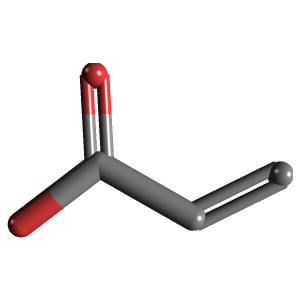
Acrylic acid is a alpha,beta-unsaturated monocarboxylic acid that is ethene substituted by a carboxy group. It has a role as a metabolite. It is a conjugate acid of an acrylate.
3D conformer
prop-2-enoic acid Formula
- CAS Number
- 79-10-7
- Molecular formula
- C3H4O2
- Molecular weight
- 72.06
- Exact mass
- 72.021129366
- IUPAC name
- prop-2-enoic acid
- SMILES
C=CC(=O)O- InChI
InChI=1S/C3H4O2/c1-2-3(4)5/h2H,1H2,(H,4,5)- InChIKey
NIXOWILDQLNWCW-UHFFFAOYSA-N
Data source: Pubchem
view
prop-2-enoic acid Synonyms (186 total)
201-177-9
2-Propenic acid, homopolymer
2-Propenoic-1-13C acid(9CI)
2-Propenoic acid
2-propeonic acid
629-850-6
79-10-7
9063-87-0
A0141
Acide acrylique
Acide acrylique [French]
Acido acrilio
Acido acrilio [Spanish]
ACRLYLIC ACID
Acroleic acid
ACRYLIC ACID
Acrylic acid, glacial
ACRYLIC ACID [HSDB]
ACRYLIC ACID [IARC]
Acrylic acid, inhibited
4-02-00-01455 (Beilstein Handbook Reference)
Acritamer 940;Lanopol 940;Acrypol 940;Phytogel base
Acrylic acid-1-13C, 487899_ALDRICH, 95387-98-7
Acrylic acid, anhydrous, contains 200 ppm MEHQ as inhibitor, 99%
Acrylic Acid contains 200ppm MEHQ as inhibitor
Acrylic Acid(Discontinued,See C4X-185055)
Acrylic acid, inhibited [UN2218] [Corrosive]
ACRYLIC ACID [MI]
Acrylic acid, p.a., 99%
Acrylic acid resin
Acrylic acid, SAJ first grade, >=97.0%, contains 190-210 ppm MEHQ as stabilizer
Acrylic acid sodium salt
Acrylic acid - stabilised with MEHQ
Acrylic Acid (stabilized with MEHQ)
Acrylic resin
Acrysol A-1
Acrysol ase-75
Acrysol lmw-20X
Acrysol WS-24
AI3-15717
AKOS000118799
aqueous acrylic acid (technical grade is 94%)
Atracurium Impurity 55
BP-30259
BRN 0635743
C00511
C19501
C3:1n-1
Carbomer 910
Carbomer 910 [USAN:NF]
Carbomer 934p [USAN]
Carbomer 934 [USAN]
Carbomer 940 [USAN]
Carbopol 910
Carbopol 934p
Carbopol 960
Carbopol 961
Carbopol 980
Carpolene
CAS-79-10-7
Caswell No. 009A
CCRIS 3234
CCRIS 737
CH2=CHCOOH
CHEBI:18308
CHEMBL1213529
CIA32654
DB02579
DB-220116
DB-251641
DTXCID8028
DTXSID0039229
EBC-48027
EC 201-177-9
EIA25963
EINECS 201-177-9
EN300-17959
Ethylenecarboxylic acid
F0001-2070
FA01586
FA 3:1
FP34494
G-Cure
Glacial acrylic acid
glacial acrylic acid (98% in aqueous solution)
Good-rite K 37
Good-rite K-700
Good-rite K 702
Good-rite K727
Good-rite K 732
Good-rite WS 801
Haloflex 202
HSDB 1421
HSDB 7826
hydron;prop-2-enoate
InChI=1/C3H4O2/c1-2-3(4)5/h2H,1H2,(H,4,5
J94PBK7X8S
KLA13882
Kyselina akrylova
Kyselina akrylova [Czech]
LMFA01030193
MFCD00004367
MFCD00084394
MFCD00084460
MSK001124
NCGC00166246-01
Neocryl A-1038
NS00001146
NSC 106034
NSC-106034
NSC106034
NSC 106035
NSC-106035
NSC106035
NSC 106036
NSC-106036
NSC106036
NSC 106037
NSC-106037
NSC106037
NSC 112122
NSC-112122
NSC112122
NSC 112123
NSC-112123
NSC112123
NSC 114472
NSC-114472
NSC114472
NSC 165257
NSC-165257
NSC165257
NSC-226569
NSC226569
NSC 4765
NSC-4765
NSC4765
P-11H
PAA-25
PAA Polymer
Poly(acrylic acid),
Poly(acrylic acid) 50% solution
Polyacrylic acid aqueous solution
Poly(acrylic acid), M.W ~2,000
Poly(acrylic acid), M.W ~3,000
Poly(acrylic acid), M.W ~450,000
Poly(acrylic acid), powder, M.W ~2000
Poly(acrylic acid) solution
Poly(acrylic acid) solution pound PAA pound(c)
prop-2-enoic acid
Propene acid
Propenoate
Propenoic acid
Q324628
Racecadotril Impurity N
RCRA waste no. U008
RCRA waste number U008
RefChem:6780
Revacryl A191
SCHEMBL15348318
SCHEMBL24390
SCHEMBL26623
SCHEMBL4482
SCHEMBL6685040
SCHEMBL8669821
SCHEMBL9016194
SCHEMBL93819
SCHEMBL9925634
STR00040
SY011058
Synthemul 90-588
Tox21_112372
UN2218
UN 2218 (Salt/Mix)
UNII-73861X4K5F
UNII-9G2MAD7J6W
UNII-A8371R0U5J
UNII-D0I6NSZ87U
UNII-J94PBK7X8S
UNII-KD3S7H73D3
VDA38798
Vinylformic acid
Viscalex HV 30
WLN: QV1U1
XPA
Z57127944
prop-2-enoic acid Safety & hazards
Signal wordDanger
Hazard statements
- H226: Flammable liquid and vapor [Warning Flammable liquids]
- H302: Harmful if swallowed [Warning Acute toxicity, oral]
- H312: Harmful in contact with skin [Warning Acute toxicity, dermal]
- H314: Causes severe skin burns and eye damage [Danger Skin corrosion/irritation]
- H332: Harmful if inhaled [Warning Acute toxicity, inhalation]
- H400: Very toxic to aquatic life [Warning Hazardous to the aquatic environment, acute hazard]
- H226 (> 99.9%): Flammable liquid and vapor [Warning Flammable liquids]
- H302+H312+H332 (32.1%): Harmful if swallowed, in contact with skin or if inhaled [Warning Acute toxicity, oral; acute toxicity, dermal; acute toxicity, inhalation]
- H302 (99.9%): Harmful if swallowed [Warning Acute toxicity, oral]
- H312 (99.4%): Harmful in contact with skin [Warning Acute toxicity, dermal]
- H314 (> 99.9%): Causes severe skin burns and eye damage [Danger Skin corrosion/irritation]
- H318 (22.2%): Causes serious eye damage [Danger Serious eye damage/eye irritation]
- H332 (99.6%): Harmful if inhaled [Warning Acute toxicity, inhalation]
- H335 (71.9%): May cause respiratory irritation [Warning Specific target organ toxicity, single exposure; Respiratory tract irritation]
- H400 (> 99.9%): Very toxic to aquatic life [Warning Hazardous to the aquatic environment, acute hazard]
- H411 (21.5%): Toxic to aquatic life with long lasting effects [Hazardous to the aquatic environment, long-term hazard]
- H311: Toxic in contact with skin [Danger Acute toxicity, dermal]
- H318: Causes serious eye damage [Danger Serious eye damage/eye irritation]
- H331: Toxic if inhaled [Danger Acute toxicity, inhalation]
- H370: Causes damage to organs [Danger Specific target organ toxicity, single exposure]
- H371: May cause damage to organs [Warning Specific target organ toxicity, single exposure]
- H372: Causes damage to organs through prolonged or repeated exposure [Danger Specific target organ toxicity, repeated exposure]
- H411: Toxic to aquatic life with long lasting effects [Hazardous to the aquatic environment, long-term hazard]
- H335: May cause respiratory irritation [Warning Specific target organ toxicity, single exposure; Respiratory tract irritation]
Data sourced from PubChem