Agrochemical Industry Government Scheme 5000-7500 Proposed
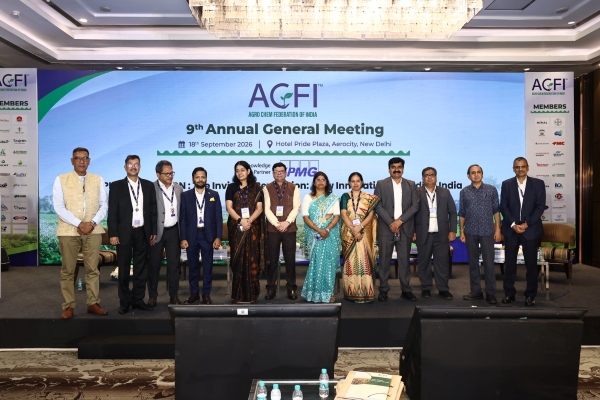
India’s agrochemical industry could see a new policy support framework aimed at strengthening domestic manufacturing of crop-protection technicals and intermediates and reducing dependence on overseas supply, particularly from China.
The Agro Chem Federation of India (ACFI) has proposed a ₹5,000-7,500 crore government support programme as part of a broader strategy to improve the competitiveness and self-reliance of India's crop-protection industry. The recommendations are contained in a knowledge paper prepared by ACFI with consultancy KPMG.
A Seven-to-Eight-Year Support Programme
ACFI has proposed that the government consider a seven-to-eight-year programme. The initial two to three years would focus on commissioning manufacturing facilities, followed by support aimed at sustaining domestic production.
According to the proposal, incentives could include 5-8% support on incremental sales along with 30-40% subsidies on industrial electricity and shared effluent-treatment infrastructure. The objective is to address some of the cost disadvantages faced by Indian manufacturers compared with Chinese producers.
The proposed framework would also use different investment thresholds so that both large manufacturers and smaller companies could participate in greenfield as well as brownfield projects.
Focus on Domestic Manufacturing of Technicals and Intermediates
A key objective of the proposal is to strengthen India's upstream agrochemical manufacturing capabilities.
While India has established expertise in formulation, process chemistry and regulatory execution, the industry body says additional capabilities are needed in the domestic production of technical-grade products and important intermediates.
Greater domestic manufacturing could also support backward integration in strategically important parts of the crop-protection supply chain.
ACFI has therefore proposed specialised agrochemical manufacturing parks with common utilities, environmental infrastructure and other shared facilities. The report also calls for improved access to long-term financing for manufacturing investments.
Research and Development Identified as Another Priority
The proposed programme is not limited to manufacturing capacity.
ACFI has recommended capital grants for specialised research and development, with greater emphasis on developing new crop-protection products and improving India's capabilities in product development and regulatory science.
The industry body has also called for infrastructure that can help move chemical innovations from laboratory research toward commercial production.
This includes:
- Pilot-scale manufacturing facilities
- Field-validation networks
- Good Laboratory Practice (GLP) laboratories
- Residue-testing infrastructure
- Formulation-development facilities
- Research infrastructure for new crop-protection products
These facilities could help address the gap between developing a product at the research stage and successfully commercialising it at industrial scale.
Biological Crop Protection Emerging as a Growth Area
The ACFI-KPMG report also highlights biologicals as an area with significant potential for India's crop-protection industry.
India's biodiversity, fermentation capabilities and scientific talent could provide a foundation for developing biological crop-protection products. However, the report notes that commercialisation requires more than research capability.
Manufacturers need to address factors such as:
- Batch-to-batch consistency
- Formulation stability
- Scalable production
- Multi-location field validation
- Residue testing
- Regulatory requirements
- Farmer adoption
Building this supporting ecosystem could therefore become an important part of developing India's domestic biologicals industry.
Faster Regulatory Approvals Proposed
ACFI has also recommended a single digital platform for central and state-level approvals related to agrochemical manufacturing and products.
The proposal calls for time-bound approval processes and clearer regulatory pathways for biological crop-protection products.
For manufacturers, reducing uncertainty around approvals could be particularly important when planning new production facilities and bringing new products to market.
Moving Beyond Capacity Expansion
The industry's proposal goes beyond simply adding manufacturing capacity.
ACFI's report argues that India's next phase of growth in crop protection will require stronger capabilities across product development, biologicals, regulatory science, digital agriculture and innovation commercialisation.
The proposed support programme is also positioned as a way to address structural cost disadvantages rather than create permanent dependence on government subsidies.
Potential Impact on the Indian Chemical Supply Chain
If such a programme is implemented, increased investment in domestic agrochemical manufacturing could create demand across several parts of the chemical supply chain.
Potential areas of impact include:
- Agrochemical technicals
- Chemical intermediates
- Specialty chemicals
- Process chemicals
- Formulation ingredients
- Biological crop-protection products
- Manufacturing equipment
- Effluent-treatment infrastructure
- Testing and analytical services
- Research and development
For chemical manufacturers and suppliers, greater domestic production of crop-protection inputs could create opportunities for both upstream and downstream businesses.
ChemEnrich Industry View
The ACFI proposal highlights a broader shift in India's chemical industry toward supply-chain resilience, domestic manufacturing and higher-value product development.
Reducing dependence on imported agrochemical inputs would require investment across the entire ecosystem—not only in production capacity, but also in R&D, testing, regulatory infrastructure, utilities and commercialisation capabilities.
The proposed ₹5,000-7,500 crore programme is therefore part of a wider industry discussion about how India can strengthen its position in the global crop-protection supply chain.
The next developments to watch will be the government's response to the proposal, the structure of any policy support that may emerge, and whether new investments translate into commercially competitive domestic production.
Source: Agro Chem Federation of India (ACFI), KPMG knowledge paper, and reporting by PTI and other industry publications.