antimony tetroxide Chemical Formula
dioxo(oxostibanyloxy)-lambda5-stibane
antimony tetroxide CAS No: 1327-33-9 antimony tetroxide Molecular formula: O4Sb2 PubChem CID: 74002
Hazard
Warning
antimony tetroxide Chemical Manufacturers and suppliers listings
No active product listings for antimony tetroxide chemical yet.
antimony tetroxide Structure
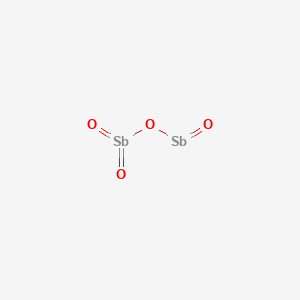
1.25×
antimony tetroxide Formula
- CAS Number
- 1327-33-9
- Molecular formula
- O4Sb2
- Molecular weight
- 307.52
- Exact mass
- 307.78769
- IUPAC name
- dioxo(oxostibanyloxy)-lambda5-stibane
- SMILES
O=[Sb]O[Sb](=O)=O- InChI
InChI=1S/4O.2Sb- InChIKey
AHBGXHAWSHTPOM-UHFFFAOYSA-N
Data source: Pubchem
view
antimony tetroxide Synonyms (21 total)
1327-33-9
1332-81-6
215-474-6
ANTIMONY ANTIMONATE (SB(SBO4))
Antimony oxide
Antimony oxide (Sb2O4)
ANTIMONY TETROXIDE
ANTIMONY TETROXIDE (SB2O4)
.BETA.-ANTIMONY TETROXIDE
Diantimony tetraoxide
DIANTIMONY TETROXIDE
DTXSID9051456
DTXSID9061677
EINECS 215-576-0
Q206765
RefChem:915989
SCHEMBL29022881
SUN EPOCH NA 5050
UNII-XB7RVZ5DN5
XB7RVZ5DN5
1lambda~5~-Distiboxane-1,1,3-trione
antimony tetroxide Safety & hazards
Signal wordWarning
Hazard statements
- H302+H332 (36.7%): Harmful if swallowed or if inhaled [Warning Acute toxicity, oral; acute toxicity, inhalation]
- H302 (100%): Harmful if swallowed [Warning Acute toxicity, oral]
- H332 (100%): Harmful if inhaled [Warning Acute toxicity, inhalation]
- H351 (36.7%): Suspected of causing cancer [Warning Carcinogenicity]
- H373 (36.7%): May causes damage to organs through prolonged or repeated exposure [Warning Specific target organ toxicity, repeated exposure]
- H411 (100%): Toxic to aquatic life with long lasting effects [Hazardous to the aquatic environment, long-term hazard]
- H315 (50%): Causes skin irritation [Warning Skin corrosion/irritation]
- H319 (50%): Causes serious eye irritation [Warning Serious eye damage/eye irritation]
- H335 (50%): May cause respiratory irritation [Warning Specific target organ toxicity, single exposure; Respiratory tract irritation]
- H315: Causes skin irritation [Warning Skin corrosion/irritation]
- H319: Causes serious eye irritation [Warning Serious eye damage/eye irritation]
- H341: Suspected of causing genetic defects [Warning Germ cell mutagenicity]
- H350: May cause cancer [Danger Carcinogenicity]
- H372: Causes damage to organs through prolonged or repeated exposure [Danger Specific target organ toxicity, repeated exposure]
Data sourced from PubChem