antimony trichloride Chemical Formula
trichlorostibane
antimony trichloride CAS No: 10025-91-9 antimony trichloride Molecular formula: Cl3Sb PubChem CID: 24814
Hazard
Danger
antimony trichloride Chemical Manufacturers and suppliers listings
No active product listings for antimony trichloride chemical yet.
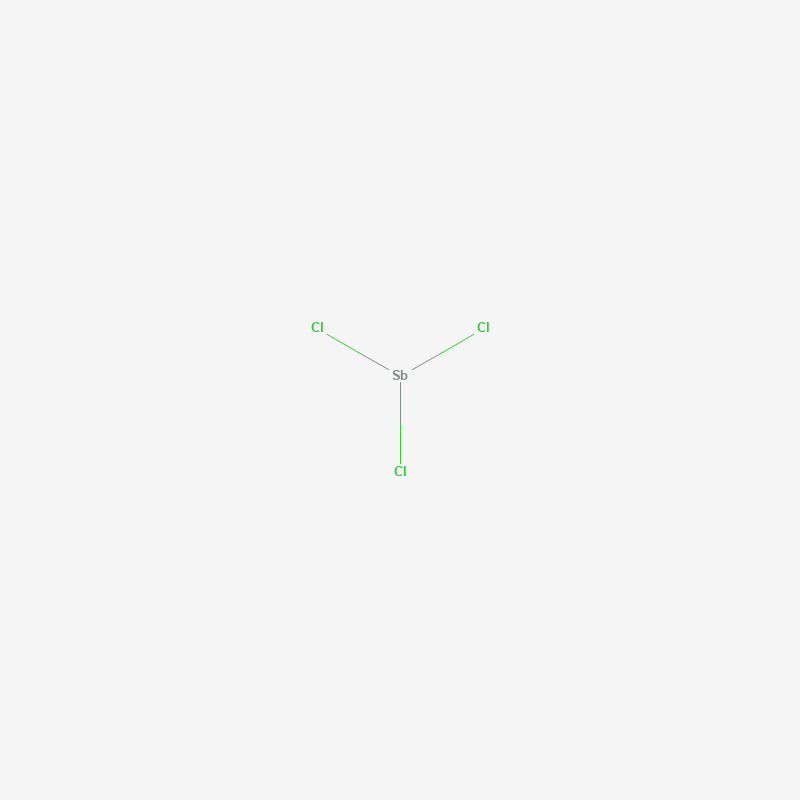
antimony trichloride Structure
1.25×
Antimony trichloride is an inorganic chloride salt with formula SbCl3. It is used as a reagent for detecting vitamin A and related carotenoids, reacting with the carotenoid to form a blue complex that can be measured by colorimetry (the Carr-Price test). Solutions of antimony trichloride were formerly used for dissolving and removing horn stubs from calves and goats. It has a role as a Lewis acid, a colorimetric reagent and an apoptosis inducer. It is an inorganic chloride and an antimony molecular entity. It derives from a hydride of a stibane.
antimony trichloride Formula
- CAS Number
- 10025-91-9
- Molecular formula
- Cl3Sb
- Molecular weight
- 228.11
- Exact mass
- 225.81037
- IUPAC name
- trichlorostibane
- SMILES
Cl[Sb](Cl)Cl- InChI
InChI=1S/3ClH.Sb/h3*1H;/q;;;+3/p-3- InChIKey
FAPDDOBMIUGHIN-UHFFFAOYSA-K
Data source: Pubchem
view
antimony trichloride Industries & Uses
Petroleum Production and Refining
Semiconductor Manufacturing
Leather Tanning and Processing
Textiles (Printing, Dyeing, or Finishing)
antimony trichloride Synonyms (70 total)
10025-91-9
233-047-2
AI3-04463
AKOS015903726
Antimoine (trichlorure d')
Antimonio (tricloruro di)
Antimonous chloride
Antimontrichlorid
Antimontrichlorid [German]
Antimony chloride
Antimony chloride (Sb2Cl6)
Antimony chloride (SbCl3)
Antimony (III) chloride
Antimony(III) chloride
Antimony(III) trichloride
ANTIMONY TRICHLORIDE
Antimony trichloride, liquid
Antimony trichloride (Sb2Cl6)
Antimony trichloride, solid
Antimoontrichlride
Antimoine (trichlorure d') [French]
Antimonio (tricloruro di) [Italian]
Antimony(III) chloride, >=99.95% trace metals basis
Antimony(III) chloride, ACS reagent, >=99.0%
Antimony(III) chloride, elec. gr.
Antimony(III) chloride, JIS special grade, >=98.0%
Antimony(III) chloride, LR, >=98.5%
Antimony(III) chloride, p.a., 99.0%
Antimony(III) chloride, Puratronic?
Antimony(III) chloride, puriss. p.a., ACS reagent, >=99.0% (RT)
Antimony(III) chloride, ReagentPlus(R), 99%
Antimony (III) chloride Trace metals grade
Antimony(III) chloride, ultra dry
Antimony trichloride, liquid [UN1733] [Corrosive]
Antimony trichloride, solid [UN1733] [Corrosive]
Antimoontrichlride [Dutch]
BP-14150
CAS-10025-91-9
Caustic antimony
CCRIS 4494
CHEBI:74856
Chlorid antimonity
Chlorid antimonity [Czech]
Chlorure antimonieux
Chlorure antimonieux [French]
C.I. 77056
CI 77056
DTXCID2024161
DTXSID4044161
EC 233-047-2
EINECS 233-047-2
HSDB 439
J281401KK3
KAA02591
NCGC00248122-01
NCGC00254549-01
NS00082494
Q411279
RefChem:113181
SbCl3
SCHEMBL15549
Stibine, trichloro-
Tox21_300641
trichloridoantimony
trichlorostibane
Trichlorostibine
Trichlorure D'antimoine
Trichlorure d'antimoine [French]
UN1733
UNII-J281401KK3
antimony trichloride Safety & hazards
Signal wordDanger
Hazard statements
- H314: Causes severe skin burns and eye damage [Danger Skin corrosion/irritation]
- H411: Toxic to aquatic life with long lasting effects [Hazardous to the aquatic environment, long-term hazard]
- H314 (100%): Causes severe skin burns and eye damage [Danger Skin corrosion/irritation]
- H318 (32.3%): Causes serious eye damage [Danger Serious eye damage/eye irritation]
- H411 (100%): Toxic to aquatic life with long lasting effects [Hazardous to the aquatic environment, long-term hazard]
- H350: May cause cancer [Danger Carcinogenicity]
- H401: Toxic to aquatic life [Hazardous to the aquatic environment, acute hazard]
- H302: Harmful if swallowed [Warning Acute toxicity, oral]
- H315: Causes skin irritation [Warning Skin corrosion/irritation]
- H319: Causes serious eye irritation [Warning Serious eye damage/eye irritation]
- H341: Suspected of causing genetic defects [Warning Germ cell mutagenicity]
- H371: May cause damage to organs [Warning Specific target organ toxicity, single exposure]
- H372: Causes damage to organs through prolonged or repeated exposure [Danger Specific target organ toxicity, repeated exposure]
- H402: Harmful to aquatic life [Hazardous to the aquatic environment, acute hazard]
- H412: Harmful to aquatic life with long lasting effects [Hazardous to the aquatic environment, long-term hazard]
- H361: Suspected of damaging fertility or the unborn child [Warning Reproductive toxicity]
- H318: Causes serious eye damage [Danger Serious eye damage/eye irritation]
Data sourced from PubChem
