arsenic pentoxide Chemical Formula
arsenic pentoxide CAS No: 1303-28-2 arsenic pentoxide Molecular formula: As2O5 PubChem CID: 14771
Hazard
Danger
arsenic pentoxide Chemical Manufacturers and suppliers listings
No active product listings for arsenic pentoxide chemical yet.
arsenic pentoxide Structure
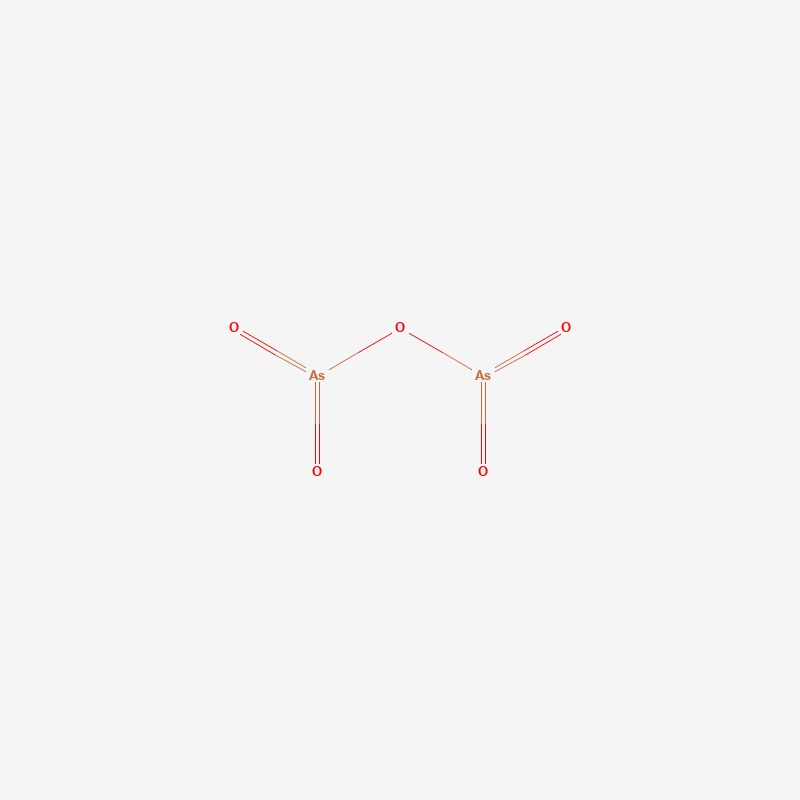
1.25×
arsenic pentoxide Formula
- CAS Number
- 1303-28-2
- Molecular formula
- As2O5
- Molecular weight
- 229.84
- Exact mass
- 229.81776
- SMILES
O=[As](=O)O[As](=O)=O- InChI
InChI=1S/As2O5/c3-1(4)7-2(5)6- InChIKey
COHDHYZHOPQOFD-UHFFFAOYSA-N
Data source: Pubchem
view
arsenic pentoxide Synonyms (43 total)
1303-28-2
215-116-9
4GWL8T475I
AKOS030254967
Anhydride arsenique
Anhydride arsenique [French]
Arsenic(5+) oxide
Arsenic acid anhydride
Arsenic anhydride
Arsenic oxide (As2O5)
Arsenic oxide As2O5
Arsenic pentaoxide
ARSENIC PENTOXIDE
ARSENIC PENTOXIDE [HSDB]
ARSENIC PENTOXIDE [MI]
ARSENIC PENTOXIDE [WHO-DD]
arsenic (V) oxide
Arsenic(V) oxide
Arsenic(V) oxide, 99%
Arsenic(V) pentoxide
3-Oxo-1lambda~5~,3lambda~5~-diarsoxane-1,1,3-trione
Arsenic pentoxide [UN1559] [Poison]
arsenic(v)oxide,arsenic acid anhydride,arsenic oxide
As2O5
Caswell No. 057
Diarsenic pentaoxide
Diarsenic pentoxide
diarsooxidane
DTXSID1034343
EINECS 215-116-9
EPA Pesticide Chemical Code 006802
FOTOX
HSDB 429
MFCD00003434
NS00093567
NSC 135808
Q411256
RCRA waste no. P011
RCRA waste number P011
RefChem:114187
SCHEMBL53923
UN1559
UNII-4GWL8T475I
arsenic pentoxide Safety & hazards
Signal wordDanger
Hazard statements
- H301: Toxic if swallowed [Danger Acute toxicity, oral]
- H331: Toxic if inhaled [Danger Acute toxicity, inhalation]
- H350: May cause cancer [Danger Carcinogenicity]
- H400: Very toxic to aquatic life [Warning Hazardous to the aquatic environment, acute hazard]
- H410: Very toxic to aquatic life with long lasting effects [Warning Hazardous to the aquatic environment, long-term hazard]
- H300 (52.7%): Fatal if swallowed [Danger Acute toxicity, oral]
- H301+H331 (31.1%): Toxic if swallowed or if inhaled [Danger Acute toxicity, oral; acute toxicity, inhalation]
- H301 (47.3%): Toxic if swallowed [Danger Acute toxicity, oral]
- H331 (100%): Toxic if inhaled [Danger Acute toxicity, inhalation]
- H350 (100%): May cause cancer [Danger Carcinogenicity]
- H400 (100%): Very toxic to aquatic life [Warning Hazardous to the aquatic environment, acute hazard]
- H410 (100%): Very toxic to aquatic life with long lasting effects [Warning Hazardous to the aquatic environment, long-term hazard]
- H300: Fatal if swallowed [Danger Acute toxicity, oral]
- H315: Causes skin irritation [Warning Skin corrosion/irritation]
- H319: Causes serious eye irritation [Warning Serious eye damage/eye irritation]
- H360: May damage fertility or the unborn child [Danger Reproductive toxicity]
- H370: Causes damage to organs [Danger Specific target organ toxicity, single exposure]
- H372: Causes damage to organs through prolonged or repeated exposure [Danger Specific target organ toxicity, repeated exposure]
- H361: Suspected of damaging fertility or the unborn child [Warning Reproductive toxicity]
- H312: Harmful in contact with skin [Warning Acute toxicity, dermal]
- H314: Causes severe skin burns and eye damage [Danger Skin corrosion/irritation]
- H341: Suspected of causing genetic defects [Warning Germ cell mutagenicity]
- H373: May causes damage to organs through prolonged or repeated exposure [Warning Specific target organ toxicity, repeated exposure]
Data sourced from PubChem
