barium chloride Chemical Formula
barium(2+) dichloride
barium chloride CAS No: 10361-37-2 barium chloride Molecular formula: BaCl2 PubChem CID: 25204
Hazard
Danger
barium chloride Chemical Manufacturers and suppliers listings
No active product listings for barium chloride chemical yet.
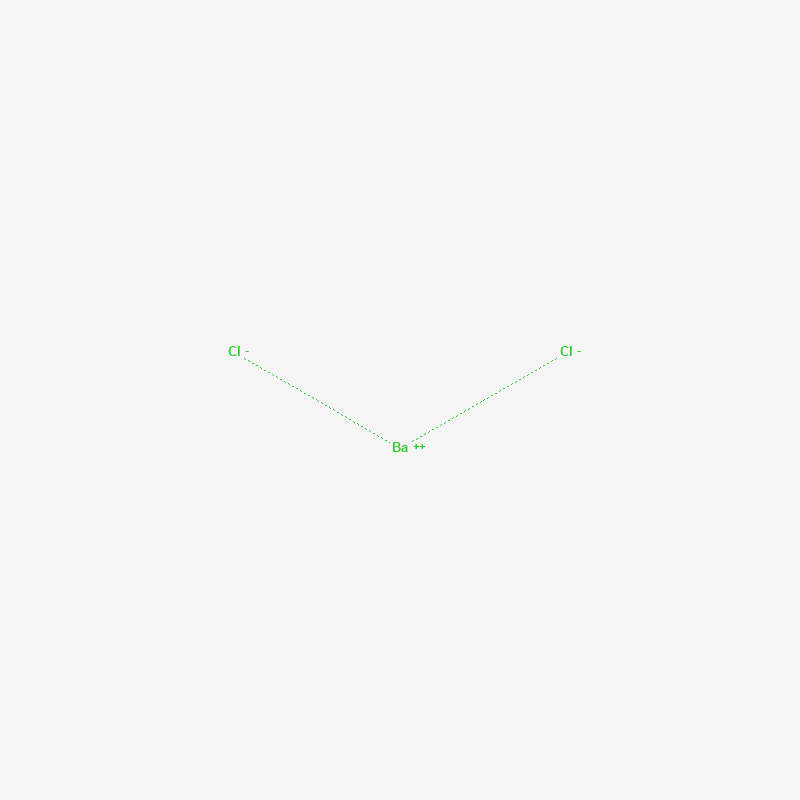
barium chloride Structure
1.25×
barium chloride Formula
- CAS Number
- 10361-37-2
- Molecular formula
- BaCl2
- Molecular weight
- 208.23
- Exact mass
- 207.842952
- IUPAC name
- barium(2+) dichloride
- SMILES
[Cl-].[Cl-].[Ba+2]- InChI
InChI=1S/Ba.2ClH/h;2*1H/q+2;;/p-2- InChIKey
WDIHJSXYQDMJHN-UHFFFAOYSA-L
Data source: Pubchem
view
barium chloride Industries & Uses
Aluminum Producing
Steel Producing
Metal Preparation and Pouring
Textiles (Fiber & Fabric Manufacturing)
Leather Tanning and Processing
Glass Manufacturing
barium chloride Synonyms (40 total)
0VK51DA1T2
10361-37-2
233-788-1
Ba 0108E
Ba-0108E
BaCl2
Bariumchlorid
Barium chloride
Barium chloride, anhydrous
Barium chloride (BaCl2)
Barium chloride, ultra dry
Barium dichloride
BP-30126
CCRIS 2286
CHEBI:63317
DICHLOROBARIUM
DTXCID5024508
DTXSID7044508
EC 233-788-1
EINECS 233-788-1
Barium chloride, 99.999% trace metals basis
Barium chloride, 99.9% trace metals basis
Barium chloride Analytical Titrant
Barium chloride, anhydrous, beads, -10 mesh, 99.95% trace metals basis
Barium chloride, anhydrous, beads, -10 mesh, 99.999% trace metals basis
Barium Chloride Dihydrate (8CI); Barium Chloride (BaCl2) Hydrate; Barium Dichloride Dihydrate
Barium chloride, p.a., 99.0%
Barium standard for AAS, ready-to-use, traceable to BAM, in H2O
HSDB 2633
NCGC00248255-01
NCI-C61074
NS00076389
NSC 146181
NSC-146181
NSC146181
RefChem:5582
SBA 0108E
SCHEMBL1857272
UNII-0VK51DA1T2
WLN: BA G2
barium chloride Safety & hazards
Signal wordDanger
Hazard statements
- H301: Toxic if swallowed [Danger Acute toxicity, oral]
- H332: Harmful if inhaled [Warning Acute toxicity, inhalation]
- H301 (99.5%): Toxic if swallowed [Danger Acute toxicity, oral]
- H319 (75%): Causes serious eye irritation [Warning Serious eye damage/eye irritation]
- H332 (99.7%): Harmful if inhaled [Warning Acute toxicity, inhalation]
- H413 (14.2%): May cause long lasting harmful effects to aquatic life [Hazardous to the aquatic environment, long-term hazard]
- H315: Causes skin irritation [Warning Skin corrosion/irritation]
- H319: Causes serious eye irritation [Warning Serious eye damage/eye irritation]
- H335: May cause respiratory irritation [Warning Specific target organ toxicity, single exposure; Respiratory tract irritation]
- H370: Causes damage to organs [Danger Specific target organ toxicity, single exposure]
- H372: Causes damage to organs through prolonged or repeated exposure [Danger Specific target organ toxicity, repeated exposure]
- H402: Harmful to aquatic life [Hazardous to the aquatic environment, acute hazard]
- H412: Harmful to aquatic life with long lasting effects [Hazardous to the aquatic environment, long-term hazard]
- H336: May cause drowsiness or dizziness [Warning Specific target organ toxicity, single exposure; Narcotic effects]
- H371: May cause damage to organs [Warning Specific target organ toxicity, single exposure]
- H373: May causes damage to organs through prolonged or repeated exposure [Warning Specific target organ toxicity, repeated exposure]
Data sourced from PubChem
