cadmium nitrate Chemical Formula
cadmium(2+) dinitrate
cadmium nitrate CAS No: 10325-94-7 cadmium nitrate Molecular formula: CdN2O6 PubChem CID: 25154
Hazard
Danger
cadmium nitrate Chemical Manufacturers and suppliers listings
No active product listings for cadmium nitrate chemical yet.
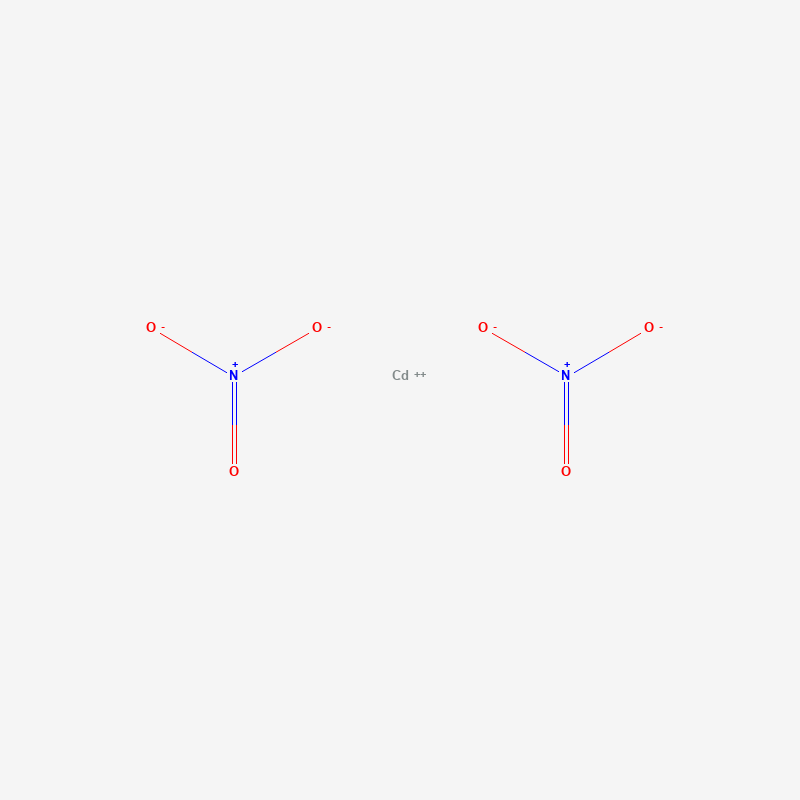
cadmium nitrate Structure
1.25×
Cadmium nitrate is an inorganic nitrate salt having Cd(2+) as the counterion. It has a role as a genotoxin, a carcinogenic agent and a hepatotoxic agent. It is a cadmium salt and an inorganic nitrate salt. It contains a cadmium(2+).
cadmium nitrate Formula
- CAS Number
- 10325-94-7
- Molecular formula
- CdN2O6
- Molecular weight
- 236.42
- Exact mass
- 237.879001
- IUPAC name
- cadmium(2+) dinitrate
- SMILES
[N+](=O)([O-])[O-].[N+](=O)([O-])[O-].[Cd+2]- InChI
InChI=1S/Cd.2NO3/c;2*2-1(3)4/q+2;2*-1- InChIKey
XIEPJMXMMWZAAV-UHFFFAOYSA-N
Data source: Pubchem
view
cadmium nitrate Industries & Uses
Battery Manufacturing
Photographic Processing
Glass Manufacturing
Ceramics making
cadmium nitrate Synonyms (31 total)
10325-94-7
14177-24-3
233-710-6
AI3-51840
AKOS015833343
cadmium(2+);dinitrate
Cadmium dinitrate
Cadmium(II) nitrate
cadmium-nitrate
CADMIUM NITRATE
CADMIUM NITRATE [HSDB]
CADMIUM NITRATE [MI]
Cd(NO3)2
CHEBI:77732
DB-264614
DTXCID5024504
DTXSID7044504
EINECS 233-710-6
HSDB 276
Nitric acid, cadmium salt
cadmium(+2) cation dinitrate
Cadmium nitrate solution, 0.1 N
Nitric acid cadmium salt (2:1)
Nitric acid, cadmium salt (2:1)
(nitrooxy)cadmio nitrate
NS00086909
Q419670
RefChem:122587
SCHEMBL136652
UNII-VF9RQV8VXV
VF9RQV8VXV
cadmium nitrate Safety & hazards
Signal wordDanger
Hazard statements
- H302: Harmful if swallowed [Warning Acute toxicity, oral]
- H312: Harmful in contact with skin [Warning Acute toxicity, dermal]
- H332: Harmful if inhaled [Warning Acute toxicity, inhalation]
- H340: May cause genetic defects [Danger Germ cell mutagenicity]
- H350: May cause cancer [Danger Carcinogenicity]
- H372: Causes damage to organs through prolonged or repeated exposure [Danger Specific target organ toxicity, repeated exposure]
- H400: Very toxic to aquatic life [Warning Hazardous to the aquatic environment, acute hazard]
- H410: Very toxic to aquatic life with long lasting effects [Warning Hazardous to the aquatic environment, long-term hazard]
- H301 (90%): Toxic if swallowed [Danger Acute toxicity, oral]
- H302+H312+H332 (31.4%): Harmful if swallowed, in contact with skin or if inhaled [Warning Acute toxicity, oral; acute toxicity, dermal; acute toxicity, inhalation]
- H302 (10%): Harmful if swallowed [Warning Acute toxicity, oral]
- H312 (42.9%): Harmful in contact with skin [Warning Acute toxicity, dermal]
- H330 (90%): Fatal if inhaled [Danger Acute toxicity, inhalation]
- H332 (10%): Harmful if inhaled [Warning Acute toxicity, inhalation]
- H340 (90%): May cause genetic defects [Danger Germ cell mutagenicity]
- H350 (92.9%): May cause cancer [Danger Carcinogenicity]
- H360 (88.6%): May damage fertility or the unborn child [Danger Reproductive toxicity]
- H372 (90%): Causes damage to organs through prolonged or repeated exposure [Danger Specific target organ toxicity, repeated exposure]
- H400 (100%): Very toxic to aquatic life [Warning Hazardous to the aquatic environment, acute hazard]
- H410 (100%): Very toxic to aquatic life with long lasting effects [Warning Hazardous to the aquatic environment, long-term hazard]
- H301: Toxic if swallowed [Danger Acute toxicity, oral]
- H341: Suspected of causing genetic defects [Warning Germ cell mutagenicity]
- H361: Suspected of damaging fertility or the unborn child [Warning Reproductive toxicity]
- H370: Causes damage to organs [Danger Specific target organ toxicity, single exposure]
- H330: Fatal if inhaled [Danger Acute toxicity, inhalation]
Data sourced from PubChem