cadmium sulfate Chemical Formula
cadmium(2+) sulfate
cadmium sulfate CAS No: 10124-36-4 cadmium sulfate Molecular formula: CdO4S PubChem CID: 24962
Hazard
Danger
cadmium sulfate Chemical Manufacturers and suppliers listings
No active product listings for cadmium sulfate chemical yet.
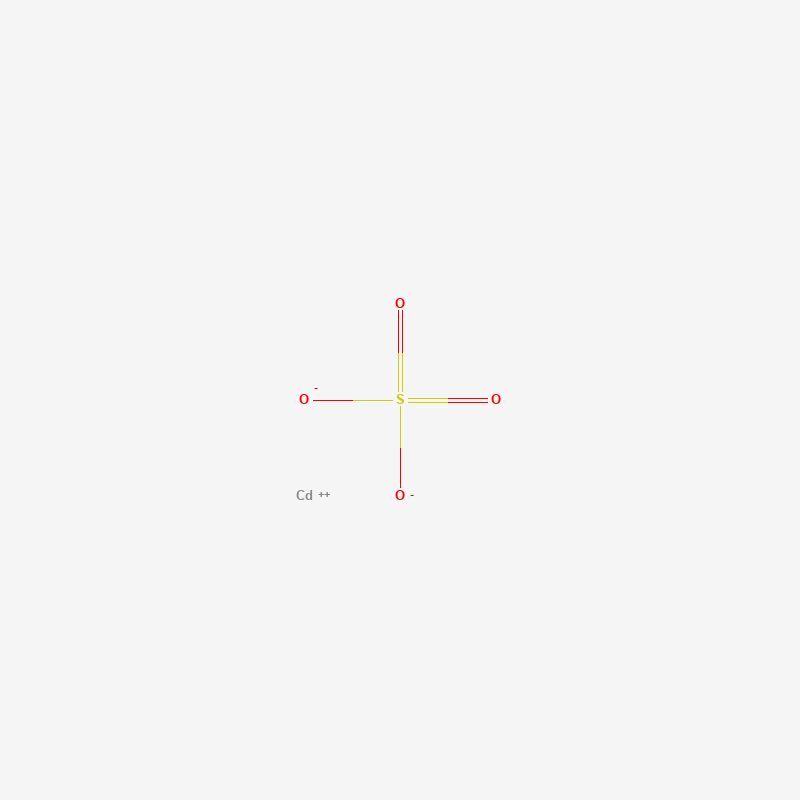
cadmium sulfate Structure
1.25×
Cadmium sulfate is a cadmium salt.
cadmium sulfate Formula
- CAS Number
- 10124-36-4
- Molecular formula
- CdO4S
- Molecular weight
- 208.48
- Exact mass
- 209.855095
- IUPAC name
- cadmium(2+) sulfate
- SMILES
[O-]S(=O)(=O)[O-].[Cd+2]- InChI
InChI=1S/Cd.H2O4S/c;1-5(2,3)4/h;(H2,1,2,3,4)/q+2;/p-2- InChIKey
QCUOBSQYDGUHHT-UHFFFAOYSA-L
Data source: Pubchem
view
cadmium sulfate Industries & Uses
Electroplating
Using Disinfectants or Biocides
Farming (Pesticides)
Cement Producing
cadmium sulfate Synonyms (55 total)
10124-36-4
13477-21-9
233-331-6
947UNF3Z6O
AKOS015915940
cadmium(2+) ion sulfate
cadmium(2+) sulfate
cadmium(2+);sulfate
Cadmium monosulfate
Cadmiumsulfat
Cadmium sulfate
Cadmium sulfate (1:1)
Cadmium sulfate, anhydrous
CADMIUM SULFATE [HSDB]
CADMIUM SULFATE, HYDRATE
CADMIUM SULFATE [MART.]
CADMIUM SULFATE [MI]
Cadmium sulfate monohydrate
CADMIUM SULFATE [WHO-DD]
Cadmium sulfuricum
Cadmium mesosulfate (CdH2SO5)
Cadmium Monosulfate; Cadmium Sulfate (Cd(SO4)); Cadmium Sulforicum
Cadmium sulfate, >=99.99% trace metals basis
Cadmium sulfate, ACS reagent, >=99.0%
Cadmium sulfate, tetrahydrate
Cadmium sulphate
Cadmium sulphate (1:1)
CADMIUM SULPHURICUM
CADMIUM SULPHURICUM [HPUS]
Caswell No. 136C
CCRIS 116
CdO4S
CdSO4
CHEBI:50292
DB-023000
DTXCID30229
DTXSID1020229
EC 233-331-6
EINECS 233-331-6
EPA Pesticide Chemical Code 012905
HSDB 274
Kadmiumsulfat
MFCD00010923
NS00093590
Q414806
QCUOBSQYDGUHHT-UHFFFAOYSA-L
RefChem:57500
SCHEMBL60875
sulfate de cadmium
sulfato de cadmio
Sulfuric acid, cadmium salt (1:1)
Sulfuric acid, cadmium salt (1:1), monohydrate
Sulfuric acid, cadmium salt, tetrahydrate
Sulphuric acid, cadmium salt (1:1)
UNII-947UNF3Z6O
cadmium sulfate Safety & hazards
Signal wordDanger
Hazard statements
- H301: Toxic if swallowed [Danger Acute toxicity, oral]
- H330: Fatal if inhaled [Danger Acute toxicity, inhalation]
- H340: May cause genetic defects [Danger Germ cell mutagenicity]
- H350: May cause cancer [Danger Carcinogenicity]
- H372 **: Causes damage to organs through prolonged or repeated exposure [Danger Specific target organ toxicity, repeated exposure]
- H400: Very toxic to aquatic life [Warning Hazardous to the aquatic environment, acute hazard]
- H410: Very toxic to aquatic life with long lasting effects [Warning Hazardous to the aquatic environment, long-term hazard]
- H301 (100%): Toxic if swallowed [Danger Acute toxicity, oral]
- H330 (100%): Fatal if inhaled [Danger Acute toxicity, inhalation]
- H340 (91.3%): May cause genetic defects [Danger Germ cell mutagenicity]
- H350 (100%): May cause cancer [Danger Carcinogenicity]
- H360 (100%): May damage fertility or the unborn child [Danger Reproductive toxicity]
- H372 (91.3%): Causes damage to organs through prolonged or repeated exposure [Danger Specific target organ toxicity, repeated exposure]
- H400 (100%): Very toxic to aquatic life [Warning Hazardous to the aquatic environment, acute hazard]
- H410 (100%): Very toxic to aquatic life with long lasting effects [Warning Hazardous to the aquatic environment, long-term hazard]
- H302: Harmful if swallowed [Warning Acute toxicity, oral]
- H315: Causes skin irritation [Warning Skin corrosion/irritation]
- H319: Causes serious eye irritation [Warning Serious eye damage/eye irritation]
- H341: Suspected of causing genetic defects [Warning Germ cell mutagenicity]
- H361: Suspected of damaging fertility or the unborn child [Warning Reproductive toxicity]
- H370: Causes damage to organs [Danger Specific target organ toxicity, single exposure]
- H372: Causes damage to organs through prolonged or repeated exposure [Danger Specific target organ toxicity, repeated exposure]
- H312: Harmful in contact with skin [Warning Acute toxicity, dermal]
Data sourced from PubChem
