calcium hypochlorite Chemical Formula
calcium dihypochlorite
calcium hypochlorite CAS No: 7778-54-3 calcium hypochlorite Molecular formula: CaCl2O2 PubChem CID: 24504
Hazard
Danger
calcium hypochlorite Chemical Manufacturers and suppliers listings
No active product listings for calcium hypochlorite chemical yet.
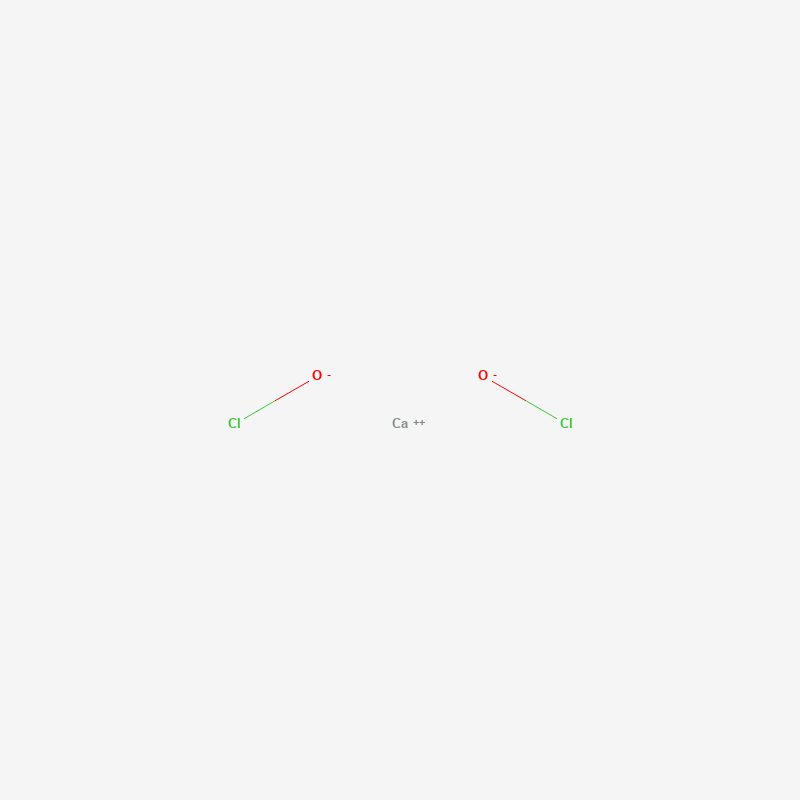
calcium hypochlorite Structure
1.25×
Calcium hypochlorite is an inorganic calcium salt and a calcium salt. It has a role as a bleaching agent. It contains a hypochlorite.
calcium hypochlorite Formula
- CAS Number
- 7778-54-3
- Molecular formula
- CaCl2O2
- Molecular weight
- 142.98
- Exact mass
- 141.8901255
- IUPAC name
- calcium dihypochlorite
- SMILES
[O-]Cl.[O-]Cl.[Ca+2]- InChI
InChI=1S/Ca.2ClO/c;2*1-2/q+2;2*-1- InChIKey
ZKQDCIXGCQPQNV-UHFFFAOYSA-N
Data source: Pubchem
view
calcium hypochlorite Industries & Uses
Pulp and Paper Processing
Using Disinfectants or Biocides
Sewer and Wastewater Treatment
Textiles (Printing, Dyeing, or Finishing)
calcium hypochlorite Synonyms (50 total)
11DXB629VZ
231-908-7
7778-54-3
AKOS015848494
AKOS015902937
B-K powder
Bleaching powder
Calcium chlorohydrochlorite
Calcium chlorohypochloride
calcium dihypochlorite
calcium;dihypochlorite
Calcium hypochloride
CALCIUM HYPOCHLORITE
CALCIUM HYPOCHLORITE [HSDB]
CALCIUM HYPOCHLORITE [MI]
Calcium oxychloride
CHEBI:31342
CHEMBL2251447
Chemichlon G
Chemichlor G
Calcium Hypochlorite (Technical Grade)
Caporit
Chloride of lime
Chlorine of lime
Chlorolime chemical
D01727
DB-023010
DTXCID309700
DTXSID1029700
EPA Pesticide Chemical Code 014701
Hipoclorito calcico
HTH (bleaching agent)
HY-Chlor
Hypochlorite de calcium
Hypochlorous acid, calcium salt
Hypochlorous acid, calcium salt (2:1)
Lime chloride
Losantin
NS00075694
NSC-21546
Pittchlor
Pittcide
Pittclor
Q407300
RefChem:5636
SCHEMBL20269
Sentry
Solvox KS
T-Eusol
UN 1748
calcium hypochlorite Safety & hazards
Signal wordDanger
Hazard statements
- H272: May intensify fire; oxidizer [Danger Oxidizing liquids; Oxidizing solids]
- H302: Harmful if swallowed [Warning Acute toxicity, oral]
- H314: Causes severe skin burns and eye damage [Danger Skin corrosion/irritation]
- H400: Very toxic to aquatic life [Warning Hazardous to the aquatic environment, acute hazard]
- H271 (12%): May cause fire or explosion; strong Oxidizer [Danger Oxidizing liquids; Oxidizing solids]
- H272 (88%): May intensify fire; oxidizer [Danger Oxidizing liquids; Oxidizing solids]
- H302 (100%): Harmful if swallowed [Warning Acute toxicity, oral]
- H314 (100%): Causes severe skin burns and eye damage [Danger Skin corrosion/irritation]
- H400 (100%): Very toxic to aquatic life [Warning Hazardous to the aquatic environment, acute hazard]
- H318: Causes serious eye damage [Danger Serious eye damage/eye irritation]
- H330: Fatal if inhaled [Danger Acute toxicity, inhalation]
- H335: May cause respiratory irritation [Warning Specific target organ toxicity, single exposure; Respiratory tract irritation]
- H317: May cause an allergic skin reaction [Warning Sensitization, Skin]
- H371: May cause damage to organs [Warning Specific target organ toxicity, single exposure]
- H410: Very toxic to aquatic life with long lasting effects [Warning Hazardous to the aquatic environment, long-term hazard]
- H313: May be harmful in contact with skin [Warning Acute toxicity, dermal]
Data sourced from PubChem
