cobalt(II) chloride hexahydrate Chemical Formula
cobalt(2+);dichloride;hexahydrate
cobalt(II) chloride hexahydrate CAS No: 7791-13-1 cobalt(II) chloride hexahydrate Molecular formula: Cl2CoH12O6 PubChem CID: 24643
Hazard
Danger
cobalt(II) chloride hexahydrate Chemical Manufacturers and suppliers listings
No active product listings for cobalt(II) chloride hexahydrate chemical yet.
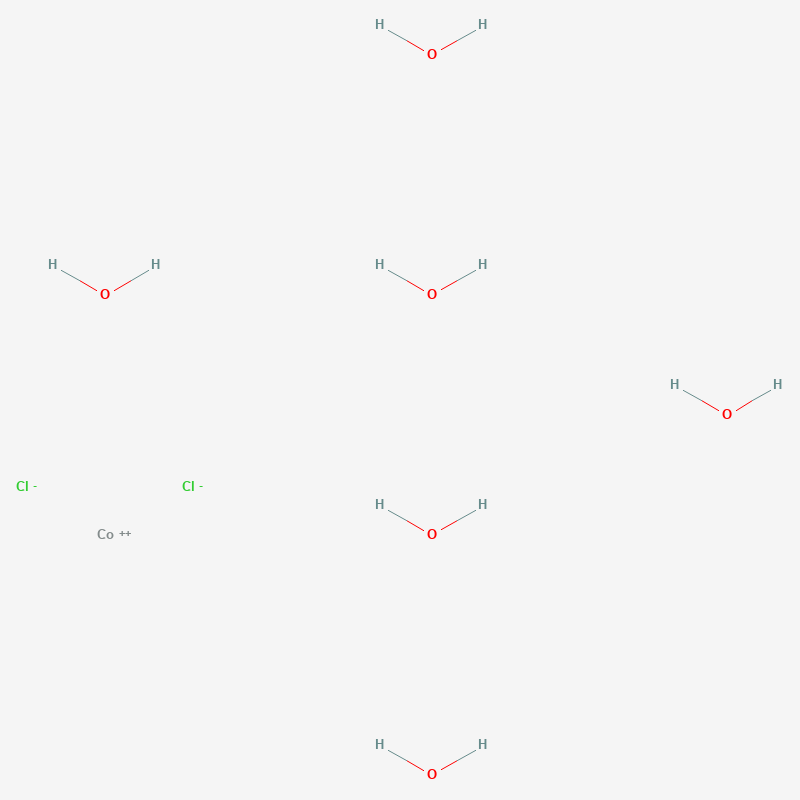
cobalt(II) chloride hexahydrate Structure
1.25×
Cobalt chloride hexahydrate is a hydrate of cobalt chloride containing cobalt (in +2 oxidation state), chloride and water moieties in the ratio 1:2:6. It has a role as an allergen. It contains a cobalt dichloride.
cobalt(II) chloride hexahydrate Formula
- CAS Number
- 7791-13-1
- Molecular formula
- Cl2CoH12O6
- Molecular weight
- 237.93
- Exact mass
- 236.934287
- IUPAC name
- cobalt(2+);dichloride;hexahydrate
- SMILES
O.O.O.O.O.O.[Cl-].[Cl-].[Co+2]- InChI
InChI=1S/2ClH.Co.6H2O/h2*1H;;6*1H2/q;;+2;;;;;;/p-2- InChIKey
GFHNAMRJFCEERV-UHFFFAOYSA-L
Data source: Pubchem
view
cobalt(II) chloride hexahydrate Synonyms (34 total)
Chlorek cobaltawy [Polish]
Cobalt(2+) chloride--water (1/2/6)
cobalt(2+) dichloride hexahydrate
cobalt(2+);dichloride;hexahydrate
Cobalt chloride (CoCl2), hexahydrate
Cobalt chloride hexahydrate
Cobalt chloride, hexahydrate
COBALT CHLORIDE HEXAHYDRATE [WHO-DD]
cobalt chloride hydrate
Cobalt dichloride hexahydrate
cobalt (II) chloride hexahydrate
COBALT(II) CHLORIDE HEXAHYDRATE
COBALT(II) CHLORIDE, HEXAHYDRATE
Cobalt(II) chloride hexahydrate, ACS grade
Cobalt(II) chloride--water (1/7)
Cobaltous chloride hexahydrate
Cobaltous chloride, hexahydrate
COBALTOUS CHLORIDE HEXAHYDRATE [MI]
cobaltous;dichloride;hexahydrate
17AVG63ZBC
616-574-6
7791-13-1
CCRIS 7729
CHEBI:53503
Chlorek cobaltawy
Cl2CoO6
cobalt chloride hexahydrate|cobalt dichloride hexahydrate|cobalt(II) chloride hexahydrate
CoCl2.6H2O
DTXSID20999109
Epitope ID:119681
F492478
RefChem:578229
SCHEMBL50980
UNII-17AVG63ZBC
cobalt(II) chloride hexahydrate Safety & hazards
Signal wordDanger
Hazard statements
- H302+H332 (17.5%): Harmful if swallowed or if inhaled [Warning Acute toxicity, oral; acute toxicity, inhalation]
- H302 (99.2%): Harmful if swallowed [Warning Acute toxicity, oral]
- H317 (88.9%): May cause an allergic skin reaction [Warning Sensitization, Skin]
- H318 (17.5%): Causes serious eye damage [Danger Serious eye damage/eye irritation]
- H332 (27.8%): Harmful if inhaled [Warning Acute toxicity, inhalation]
- H334 (99.2%): May cause allergy or asthma symptoms or breathing difficulties if inhaled [Danger Sensitization, respiratory]
- H341 (89.7%): Suspected of causing genetic defects [Warning Germ cell mutagenicity]
- H350 (71.4%): May cause cancer [Danger Carcinogenicity]
- H360 (78.6%): May damage fertility or the unborn child [Danger Reproductive toxicity]
- H400 (98.4%): Very toxic to aquatic life [Warning Hazardous to the aquatic environment, acute hazard]
- H410 (98.4%): Very toxic to aquatic life with long lasting effects [Warning Hazardous to the aquatic environment, long-term hazard]
- H302: Harmful if swallowed [Warning Acute toxicity, oral]
- H317: May cause an allergic skin reaction [Warning Sensitization, Skin]
- H318: Causes serious eye damage [Danger Serious eye damage/eye irritation]
- H334: May cause allergy or asthma symptoms or breathing difficulties if inhaled [Danger Sensitization, respiratory]
- H372: Causes damage to organs through prolonged or repeated exposure [Danger Specific target organ toxicity, repeated exposure]
Data sourced from PubChem