cobalt(II) nitrate Chemical Formula
cobalt(2+) dinitrate
cobalt(II) nitrate CAS No: 10141-05-6 cobalt(II) nitrate Molecular formula: CoN2O6 PubChem CID: 25000
Hazard
Danger
cobalt(II) nitrate Chemical Manufacturers and suppliers listings
No active product listings for cobalt(II) nitrate chemical yet.
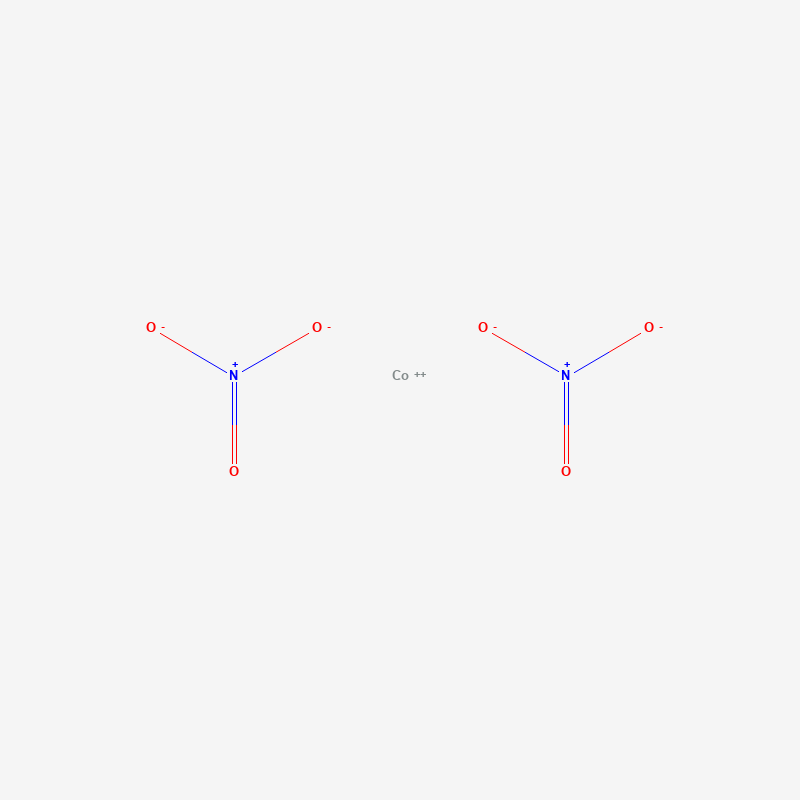
cobalt(II) nitrate Structure
1.25×
Cobalt dinitrate is a cobalt salt in which the cobalt metal is in the +2 oxidation state and the counter-anion is nitrate. It is a cobalt salt and an inorganic nitrate salt. It contains a cobalt(2+).
cobalt(II) nitrate Formula
- CAS Number
- 10141-05-6
- Molecular formula
- CoN2O6
- Molecular weight
- 182.94
- Exact mass
- 182.908829
- IUPAC name
- cobalt(2+) dinitrate
- SMILES
[N+](=O)([O-])[O-].[N+](=O)([O-])[O-].[Co+2]- InChI
InChI=1S/Co.2NO3/c;2*2-1(3)4/q+2;2*-1- InChIKey
UFMZWBIQTDUYBN-UHFFFAOYSA-N
Data source: Pubchem
view
cobalt(II) nitrate Industries & Uses
Farming (Feed Additives)
Ceramics making
cobalt(II) nitrate Synonyms (36 total)
10141-05-6
14216-74-1
19154-72-4
233-402-1
65W79BFD5V
AKOS015833344
CHEBI:86209
cobalt(2+) dinitrate
cobalt(2+);dinitrate
Cobalt(2+) nitrate
Cobalt bis(nitrate)
Cobalt dinitrate
Cobalt(II) nitrate
Cobalt nitrate
Cobalt nitrate (Co(NO3)2)
cobalt nitrate salt
COBALT NITRATE [WHO-DD]
COBALTOUS NITRATE
COBALTOUS NITRATE [HSDB]
COBALTOUS NITRATE [MI]
Co(NO3)2
DTXCID2032633
DTXSID9064970
EC 233-402-1
EINECS 233-402-1
EINECS 238-075-9
HSDB 238
lambda2-cobalt(2+) ion dinitrate
Nitric acid, cobalt(2+) salt
Nitric acid, cobalt(2+) salt (2:1)
Nitric acid, cobalt salt
NS00093505
Q414860
RefChem:578234
SCHEMBL49660
UNII-65W79BFD5V
cobalt(II) nitrate Safety & hazards
Signal wordDanger
Hazard statements
- H317: May cause an allergic skin reaction [Warning Sensitization, Skin]
- H334: May cause allergy or asthma symptoms or breathing difficulties if inhaled [Danger Sensitization, respiratory]
- H341: Suspected of causing genetic defects [Warning Germ cell mutagenicity]
- H400: Very toxic to aquatic life [Warning Hazardous to the aquatic environment, acute hazard]
- H410: Very toxic to aquatic life with long lasting effects [Warning Hazardous to the aquatic environment, long-term hazard]
- H272 (54%): May intensify fire; oxidizer [Danger Oxidizing liquids; Oxidizing solids]
- H302 (60.4%): Harmful if swallowed [Warning Acute toxicity, oral]
- H317 (100%): May cause an allergic skin reaction [Warning Sensitization, Skin]
- H318 (53.3%): Causes serious eye damage [Danger Serious eye damage/eye irritation]
- H334 (100%): May cause allergy or asthma symptoms or breathing difficulties if inhaled [Danger Sensitization, respiratory]
- H341 (100%): Suspected of causing genetic defects [Warning Germ cell mutagenicity]
- H350 (49.1%): May cause cancer [Danger Carcinogenicity]
- H360 (53%): May damage fertility or the unborn child [Danger Reproductive toxicity]
- H400 (100%): Very toxic to aquatic life [Warning Hazardous to the aquatic environment, acute hazard]
- H410 (88.4%): Very toxic to aquatic life with long lasting effects [Warning Hazardous to the aquatic environment, long-term hazard]
- H411 (11.6%): Toxic to aquatic life with long lasting effects [Hazardous to the aquatic environment, long-term hazard]
- H350: May cause cancer [Danger Carcinogenicity]
- H302: Harmful if swallowed [Warning Acute toxicity, oral]
- H318: Causes serious eye damage [Danger Serious eye damage/eye irritation]
- H335: May cause respiratory irritation [Warning Specific target organ toxicity, single exposure; Respiratory tract irritation]
- H351: Suspected of causing cancer [Warning Carcinogenicity]
- H360: May damage fertility or the unborn child [Danger Reproductive toxicity]
- H371: May cause damage to organs [Warning Specific target organ toxicity, single exposure]
- H372: Causes damage to organs through prolonged or repeated exposure [Danger Specific target organ toxicity, repeated exposure]
- H373: May causes damage to organs through prolonged or repeated exposure [Warning Specific target organ toxicity, repeated exposure]
- H314: Causes severe skin burns and eye damage [Danger Skin corrosion/irritation]
Data sourced from PubChem
