copper(II) acetate Chemical Formula
copper diacetate
copper(II) acetate CAS No: 142-71-2 copper(II) acetate Molecular formula: C4H6CuO4 PubChem CID: 8895
Hazard
Danger
copper(II) acetate Chemical Manufacturers and suppliers listings
No active product listings for copper(II) acetate chemical yet.
copper(II) acetate Structure
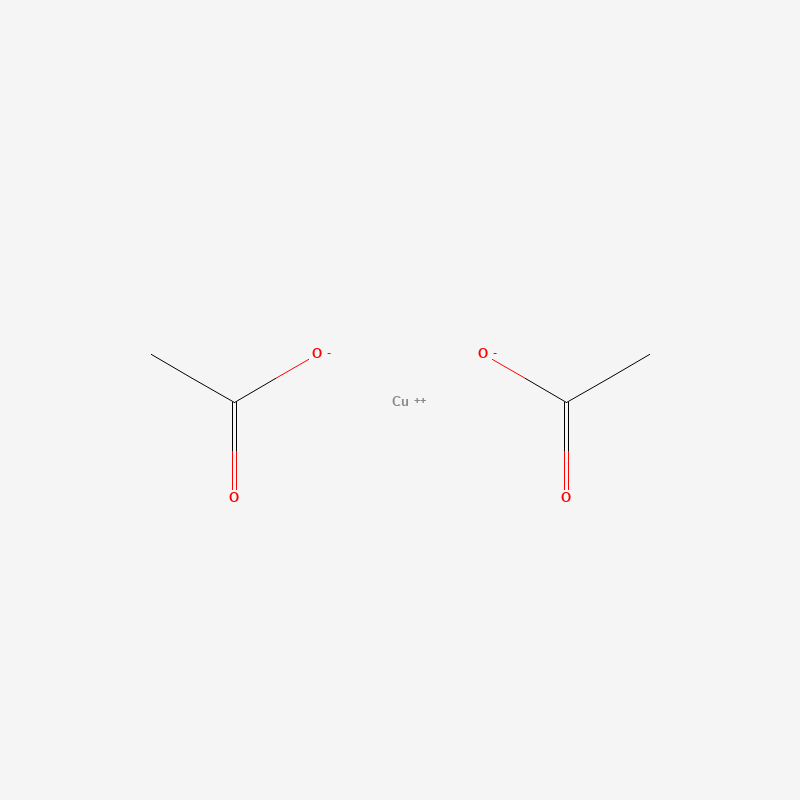
1.25×
copper(II) acetate Formula
- CAS Number
- 142-71-2
- Molecular formula
- C4H6CuO4
- Molecular weight
- 181.63
- Exact mass
- 180.956206
- IUPAC name
- copper diacetate
- SMILES
CC(=O)[O-].CC(=O)[O-].[Cu+2]- InChI
InChI=1S/2C2H4O2.Cu/c2*1-2(3)4;/h2*1H3,(H,3,4);/q;;+2/p-2- InChIKey
OPQARKPSCNTWTJ-UHFFFAOYSA-L
Data source: Pubchem
view
copper(II) acetate Industries & Uses
Farming (Pesticides)
Textiles (Printing, Dyeing, or Finishing)
Ceramics making
copper(II) acetate Synonyms (93 total)
142-71-2
205-553-3
39M11XPH03
463931-62-6
52503-64-7
Acetate de cuivre
Acetate de cuivre [French]
aceticacid,copper(2+)salt
Acetic acid copper(2+) salt
Acetic acid, copper (2+) salt
Acetic acid, copper(2+) salt
Acetic Acid Copper(II) Salt
Acetic acid, cupric salt
ACETIC ACID CUPRIC SALT
(acetyloxy)cuprio acetate
AI3-01379
AKOS015892699
Bisacetoxycopper
C4H6CuO4
CCRIS 5286
Acetic acid, copper(2+) salt (2:1)
Acetic acid, copper(2+) salt, basic
Acetic acid, copper(II) salt (2:1)
C2346
copper(11) acetate
copper(1I) acetate
Copper(2+) acetate
Copper(2+) diacetate
Copper acetate (Cu(C2H3O2)2)
Copper acetate (Cu(OAc)2)
COPPER ACETATE [MART.]
copper acetate salt
COPPER ACETATE [WHO-DD]
copper;diacetate
Copper di(acetate)
Copper diacetate
copper (II) acetate
copper (II)acetate
copper(II)-acetate
copper-(II) acetate
copper-(II)-acetate
copper-(II)acetate
Copper(II) acetate
Copper(II)acetate
Copper(II) acetate anhydrous
COPPER(II) ACETATE, ANHYDROUS
COPPER(II) ACETATE [HSDB]
Copper(II) acetate, Trace metals grade
copper (II) diacetate
copper(II) diacetate
copper(II)diacetate
Crystallized verdigris
Crystals of venus
Cu(II) acetate
Cu(OAc)2
CUPRIC ACETATE
Cupric acetate,anhydrous
Cupric Acetate Anhydrous
Cupric acetate, basic
CUPRIC ACETATE [MI]
Cupric diacetate
CUPRUM ACETICUM
Cuprum Aceticum 3
Cuprum aceticum 4 Special Order
CUPRUM ACETICUM [HPUS]
D77909
diacetoxy copper
diacetoxycopper
diacetoxy copper (II)
DTXCID8034613
DTXSID2059720
EC 205-553-3
EINECS 205-553-3
EINECS 257-974-7
F325218
F556451
FC34328
HSDB 915
MFCD00008690
Neutral verdigris
NS00093598
NSC 75796
NSC-75796
Octan mednaty
Octan mednaty [Czech]
orb2942240
Q421854
RefChem:58256
SCHEMBL1080
SY001104
TSH-00254
UNII-39M11XPH03
Venus copper
copper(II) acetate Safety & hazards
Signal wordDanger
Hazard statements
- H301 (19.8%): Toxic if swallowed [Danger Acute toxicity, oral]
- H302 (73.4%): Harmful if swallowed [Warning Acute toxicity, oral]
- H311 (19.8%): Toxic in contact with skin [Danger Acute toxicity, dermal]
- H314 (35.9%): Causes severe skin burns and eye damage [Danger Skin corrosion/irritation]
- H318 (37%): Causes serious eye damage [Danger Serious eye damage/eye irritation]
- H400 (44.3%): Very toxic to aquatic life [Warning Hazardous to the aquatic environment, acute hazard]
- H410 (22.1%): Very toxic to aquatic life with long lasting effects [Warning Hazardous to the aquatic environment, long-term hazard]
- H411 (31.2%): Toxic to aquatic life with long lasting effects [Hazardous to the aquatic environment, long-term hazard]
- H412 (19.8%): Harmful to aquatic life with long lasting effects [Hazardous to the aquatic environment, long-term hazard]
- H302: Harmful if swallowed [Warning Acute toxicity, oral]
- H335: May cause respiratory irritation [Warning Specific target organ toxicity, single exposure; Respiratory tract irritation]
- H370: Causes damage to organs [Danger Specific target organ toxicity, single exposure]
- H372: Causes damage to organs through prolonged or repeated exposure [Danger Specific target organ toxicity, repeated exposure]
Data sourced from PubChem