copper(II) hydroxide Chemical Formula
copper dihydroxide
copper(II) hydroxide CAS No: 20427-59-2 copper(II) hydroxide Molecular formula: CuH2O2 PubChem CID: 164826
Hazard
Danger
copper(II) hydroxide Chemical Manufacturers and suppliers listings
No active product listings for copper(II) hydroxide chemical yet.
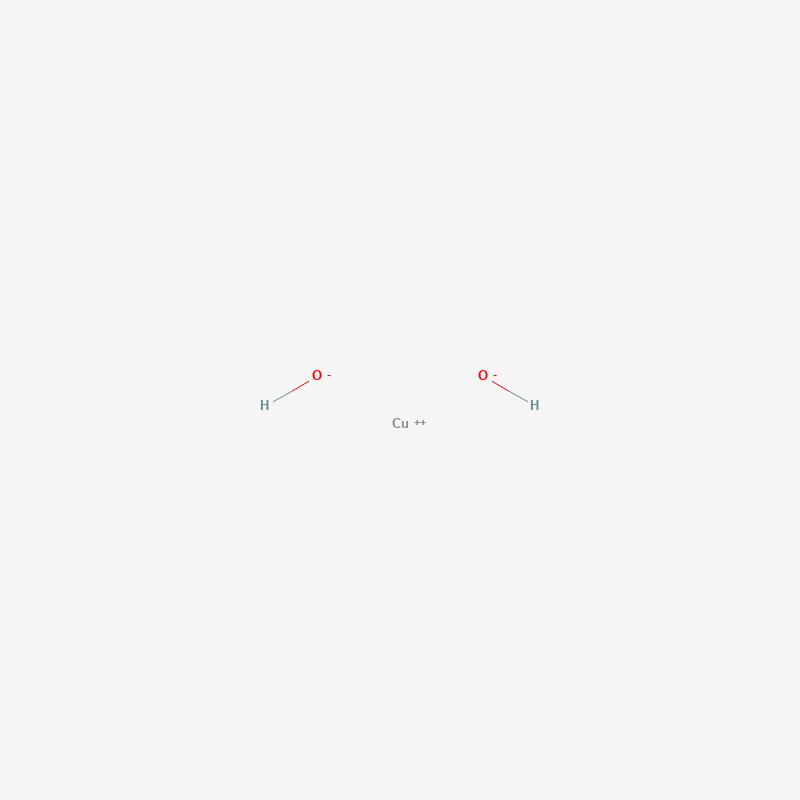
copper(II) hydroxide Structure
1.25×
Copper hydroxide is an organic molecular entity.
copper(II) hydroxide Formula
- CAS Number
- 20427-59-2
- Molecular formula
- CuH2O2
- Molecular weight
- 97.56
- Exact mass
- 96.935076
- IUPAC name
- copper dihydroxide
- SMILES
[OH-].[OH-].[Cu+2]- InChI
InChI=1S/Cu.2H2O/h;2*1H2/q+2;;/p-2- InChIKey
JJLJMEJHUUYSSY-UHFFFAOYSA-L
Data source: Pubchem
view
copper(II) hydroxide Industries & Uses
Battery Manufacturing
Pulp and Paper Processing
Textiles (Printing, Dyeing, or Finishing)
Farming (Feed Additives)
copper(II) hydroxide Synonyms (23 total)
1344-69-0
20427-59-2
243-815-9
AKOS030228342
CHEBI:81907
copper;dihydroxide
Copper dihydroxide
Copper hydroxide
COPPER(I)HYDROXIDE
copper (II) hydroxide
Copper(II) hydroxide
Cupric hydroxide
Cuprichydroxide
Cupric hydroxide (Cu(OH)2)
CUPRIC HYDROXIDE [MI]
EINECS 215-705-0
HYDRATED CUPRIC OXIDE
SCHEMBL15708759
SCHEMBL22481
C18712
CuH2O2
PEI 24
Q186357
copper(II) hydroxide Safety & hazards
Signal wordDanger
Hazard statements
- H302: Harmful if swallowed [Warning Acute toxicity, oral]
- H318: Causes serious eye damage [Danger Serious eye damage/eye irritation]
- H330: Fatal if inhaled [Danger Acute toxicity, inhalation]
- H400: Very toxic to aquatic life [Warning Hazardous to the aquatic environment, acute hazard]
- H410: Very toxic to aquatic life with long lasting effects [Warning Hazardous to the aquatic environment, long-term hazard]
- H302 (99.9%): Harmful if swallowed [Warning Acute toxicity, oral]
- H318 (66.6%): Causes serious eye damage [Danger Serious eye damage/eye irritation]
- H319 (29.7%): Causes serious eye irritation [Warning Serious eye damage/eye irritation]
- H330 (60.9%): Fatal if inhaled [Danger Acute toxicity, inhalation]
- H400 (66.8%): Very toxic to aquatic life [Warning Hazardous to the aquatic environment, acute hazard]
- H410 (48.9%): Very toxic to aquatic life with long lasting effects [Warning Hazardous to the aquatic environment, long-term hazard]
- H411 (17.7%): Toxic to aquatic life with long lasting effects [Hazardous to the aquatic environment, long-term hazard]
Data sourced from PubChem
