copper(II) nitrate Chemical Formula
copper dinitrate
copper(II) nitrate CAS No: 3251-23-8 copper(II) nitrate Molecular formula: CuN2O6 PubChem CID: 18616
Hazard
Danger
copper(II) nitrate Chemical Manufacturers and suppliers listings
No active product listings for copper(II) nitrate chemical yet.
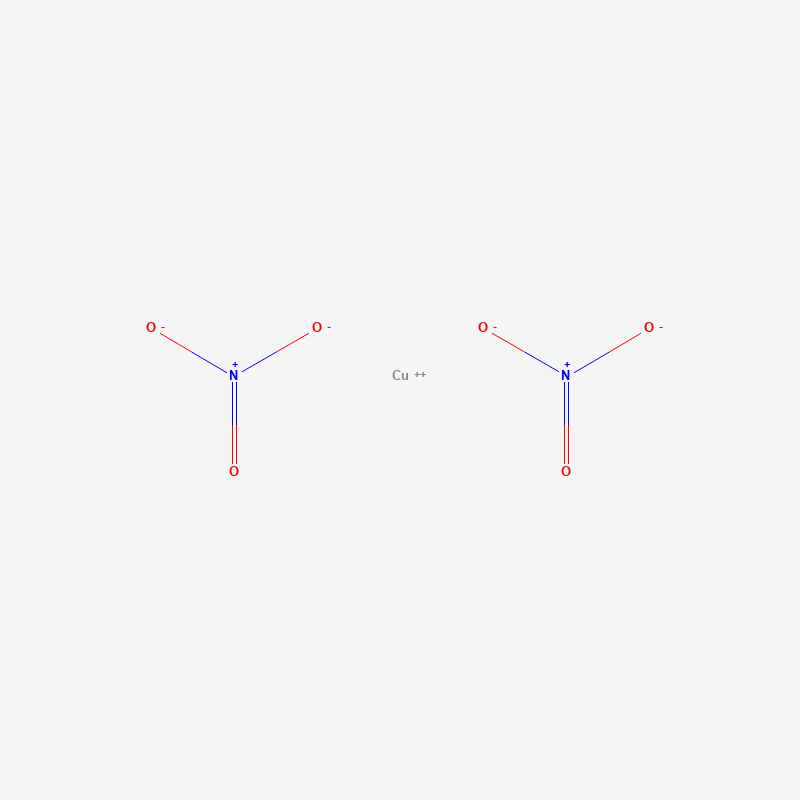
copper(II) nitrate Structure
1.25×
Copper(II) nitrate is an inorganic nitrate salt having copper(2+) as the couterion. It contains a copper(2+).
copper(II) nitrate Formula
- CAS Number
- 3251-23-8
- Molecular formula
- CuN2O6
- Molecular weight
- 187.56
- Exact mass
- 186.905233
- IUPAC name
- copper dinitrate
- SMILES
[N+](=O)([O-])[O-].[N+](=O)([O-])[O-].[Cu+2]- InChI
InChI=1S/Cu.2NO3/c;2*2-1(3)4/q+2;2*-1- InChIKey
XTVVROIMIGLXTD-UHFFFAOYSA-N
Data source: Pubchem
view
copper(II) nitrate Industries & Uses
Aluminum Producing
Electroplating
Petroleum Production and Refining
Pulp and Paper Processing
Painting (Pigments, Binders, and Biocides)
Applying Wood Preservatives
Farming (Pesticides)
Textiles (Printing, Dyeing, or Finishing)
Metal Extraction and Refining
Ceramics making
Applying metallic patinas
copper(II) nitrate Synonyms (44 total)
10402-29-6
221-838-5
3251-23-8
628-973-2
9TC879S2ZV
AKOS015903393
Caswell No. 246
CHEBI:78036
Claycop
copper(2+) dinitrate
Copper(2+) nitrate
copper;dinitrate
Copper dinitrate
copper(II) dinitrate hydrate
Copper(II) nitrate
copper(II) nitrate (anh.)
copper(II) nitrate (anhydrous)
COPPER(II) NITRATE [HSDB]
Cop-per nitrate
Copper nitrate
copper nitrate|cupric nitrate|copper(II) nitrate
COPPER NITRATE [WHO-DD]
CuN2O6
Cu(NO3)2
Cupric dinitrate
CUPRIC NITRATE
Cupric nitrate hydrate
CUPRIC NITRATE [MI]
DTXCID5020314
DTXSID7040314
EC 221-838-5
EINECS 221-838-5
EPA Pesticide Chemical Code 076102
HSDB 264
Nitric acid, copper(2+) salt
Nitric acid copper(2+) salt (2:1)
Nitric acid, copper(2+) salt (2:1)
Nitric acid, copper salt
(nitrooxy)cuprio nitrate
NS00075662
Q286064
RefChem:127903
SCHEMBL22666
UNII-9TC879S2ZV
copper(II) nitrate Safety & hazards
Signal wordDanger
Hazard statements
- H270 (13.7%): May cause or intensify fire; oxidizer [Danger Oxidizing gases]
- H272 (50.5%): May intensify fire; oxidizer [Danger Oxidizing liquids; Oxidizing solids]
- H301 (34.5%): Toxic if swallowed [Danger Acute toxicity, oral]
- H302 (33.3%): Harmful if swallowed [Warning Acute toxicity, oral]
- H314 (52.3%): Causes severe skin burns and eye damage [Danger Skin corrosion/irritation]
- H315 (42.2%): Causes skin irritation [Warning Skin corrosion/irritation]
- H318 (36.1%): Causes serious eye damage [Danger Serious eye damage/eye irritation]
- H319 (39.3%): Causes serious eye irritation [Warning Serious eye damage/eye irritation]
- H400 (79.5%): Very toxic to aquatic life [Warning Hazardous to the aquatic environment, acute hazard]
- H410 (20.3%): Very toxic to aquatic life with long lasting effects [Warning Hazardous to the aquatic environment, long-term hazard]
- H411 (31.8%): Toxic to aquatic life with long lasting effects [Hazardous to the aquatic environment, long-term hazard]
- H272 (51.4%): May intensify fire; oxidizer [Danger Oxidizing liquids; Oxidizing solids]
- H302 (51.4%): Harmful if swallowed [Warning Acute toxicity, oral]
- H314 (51.4%): Causes severe skin burns and eye damage [Danger Skin corrosion/irritation]
- H272: May intensify fire; oxidizer [Danger Oxidizing liquids; Oxidizing solids]
- H302: Harmful if swallowed [Warning Acute toxicity, oral]
Data sourced from PubChem
