iron(III) chloride Chemical Formula
trichloroiron
iron(III) chloride CAS No: 7705-08-0 iron(III) chloride Molecular formula: Cl3Fe PubChem CID: 24380
Hazard
Danger
iron(III) chloride Chemical Manufacturers and suppliers listings
No active product listings for iron(III) chloride chemical yet.
iron(III) chloride Structure
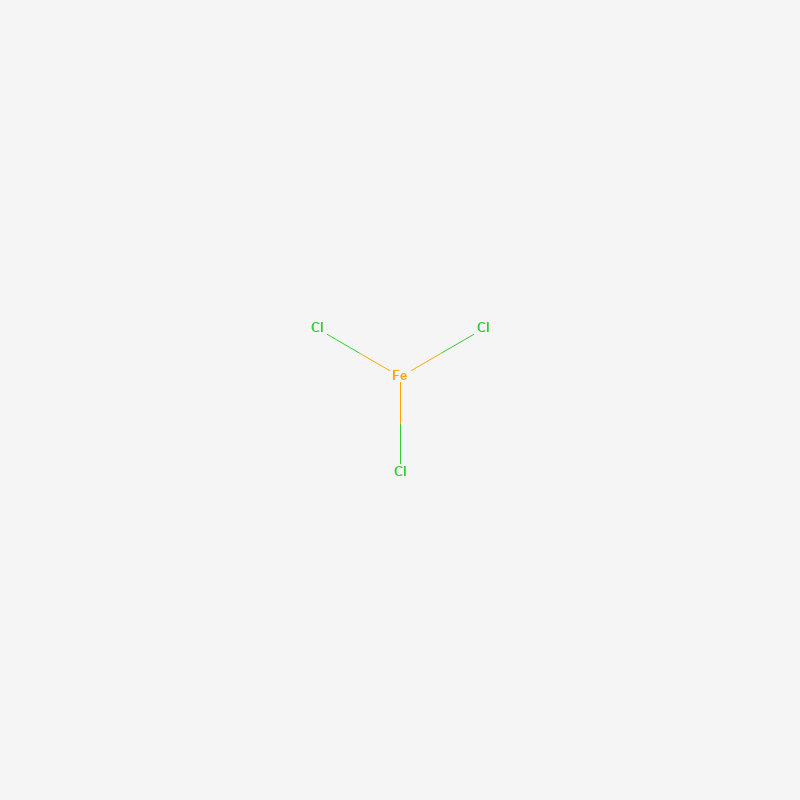
1.25×
Iron trichloride is an iron coordination entity. It has a role as a Lewis acid and an astringent.
iron(III) chloride Formula
- CAS Number
- 7705-08-0
- Molecular formula
- Cl3Fe
- Molecular weight
- 162.20
- Exact mass
- 160.841494
- IUPAC name
- trichloroiron
- SMILES
Cl[Fe](Cl)Cl- InChI
InChI=1S/3ClH.Fe/h3*1H;/q;;;+3/p-3- InChIKey
RBTARNINKXHZNM-UHFFFAOYSA-K
Data source: Pubchem
view
iron(III) chloride Industries & Uses
Using Disinfectants or Biocides
Sewer and Wastewater Treatment
Photographic Processing
Textiles (Printing, Dyeing, or Finishing)
Farming (Feed Additives)
Intalagio printing
Applying metallic patinas
iron(III) chloride Synonyms (88 total)
231-729-4
7705-08-0
AI3-51902
AKOS015902743
BP-31268
Caswell No. 459
CCRIS 2299
CHEBI:30808
Chlorure ferrique
Chlorure ferrique [French]
Chlorure perrique
Chlorure perrique [French]
DB15536
DTXCID60622
DTXSID8020622
EC 231-729-4
EINECS 231-729-4
EN300-19478
F0001-1983
[FeCl3]
EPA Pesticide Chemical Code 034901
FeCl3
Fe(III) chloride
Fe/ppm Pd for nitro group reductions
FERRIC CHLORIDE
FERRIC CHLORIDE, ANHYDROUS
Ferric chloride, anhydrous [UN1773] [Corrosive]
Ferric chloride, anhydrous [UN1773] [Corrosive]
Ferric chloride, hexahydrate
Ferric chloride hexahydrate, Iron trichloride hexahydrate
Ferric chloride, solid
Ferric trichloride
Flores martis
HSDB 449
iron(3+) chloride
Iron(3+) chloride, hexahydrate
Iron chloride
Iron chloride anhydrous
Iron chloride (Fe2Cl3)
Iron chloride (FeCl3)
Iron chloride, solid
iron (III)chloride
iron-(III) chloride
iron-(III)-chloride
Iron (III) chloride
Iron(III) chloride
Iron(III)chloride
Iron(III) chloride anhydrous
Iron(III) chloride, anhydrous, powder, >=99.99% trace metals basis
Iron(III) chloride, CP
Iron (III), chloride, hexahydrate
Iron(III) chloride, LR, anhydrous, >=97%
Iron(III) chloride on silica gel, powder, extent of labeling: 5 wt. % loading
Iron(III) chloride, p.a., 98%
Iron(III) chloride, reagent grade, 97%
Iron(III) chloride, sublimed grade, >=99.9% trace metals basis
Iron(III) chloride, technical grade, 58%
Iron (III) chloride, Trace metals grade, 99.9%
iron (III) cloride
iron (III) trichloride
Iron perchloride
Iron sesquichloride
Iron sesquichloride (DOT)
Iron trichloride
Natural molysite
NCGC00249131-01
NS00093572
NSC 135798
NSC-135798
NSC135798
NSC 51150
NSC-51150
NSC51150
orb2941054
Perchlorure de fer
Perchlorure de fer [French]
Q399771
RefChem:6640
SCHEMBL15401
TDA Reagent, for microbiology
trichloroiron
TXB-00061
U38V3ZVV3V
UN1773
UN2582
UNII-U38V3ZVV3V
USP Solution Ferric Chloride TS Conforms to USP
WLN: FE G3
iron(III) chloride Safety & hazards
Signal wordDanger
Hazard statements
- H302 (96.6%): Harmful if swallowed [Warning Acute toxicity, oral]
- H314 (75.4%): Causes severe skin burns and eye damage [Danger Skin corrosion/irritation]
- H315 (24.4%): Causes skin irritation [Warning Skin corrosion/irritation]
- H318 (24.5%): Causes serious eye damage [Danger Serious eye damage/eye irritation]
- H412 (72.4%): Harmful to aquatic life with long lasting effects [Hazardous to the aquatic environment, long-term hazard]
- H302: Harmful if swallowed [Warning Acute toxicity, oral]
- H314: Causes severe skin burns and eye damage [Danger Skin corrosion/irritation]
- H318: Causes serious eye damage [Danger Serious eye damage/eye irritation]
- H335: May cause respiratory irritation [Warning Specific target organ toxicity, single exposure; Respiratory tract irritation]
- H370: Causes damage to organs [Danger Specific target organ toxicity, single exposure]
- H402: Harmful to aquatic life [Hazardous to the aquatic environment, acute hazard]
- H371: May cause damage to organs [Warning Specific target organ toxicity, single exposure]
- H304: May be fatal if swallowed and enters airways [Danger Aspiration hazard]
- H341: Suspected of causing genetic defects [Warning Germ cell mutagenicity]
Data sourced from PubChem
