lead(II) acetate Chemical Formula
lead(2+) diacetate
lead(II) acetate CAS No: 301-04-2 lead(II) acetate Molecular formula: C4H6O4Pb PubChem CID: 9317
Hazard
Danger
lead(II) acetate Chemical Manufacturers and suppliers listings
No active product listings for lead(II) acetate chemical yet.
lead(II) acetate Structure
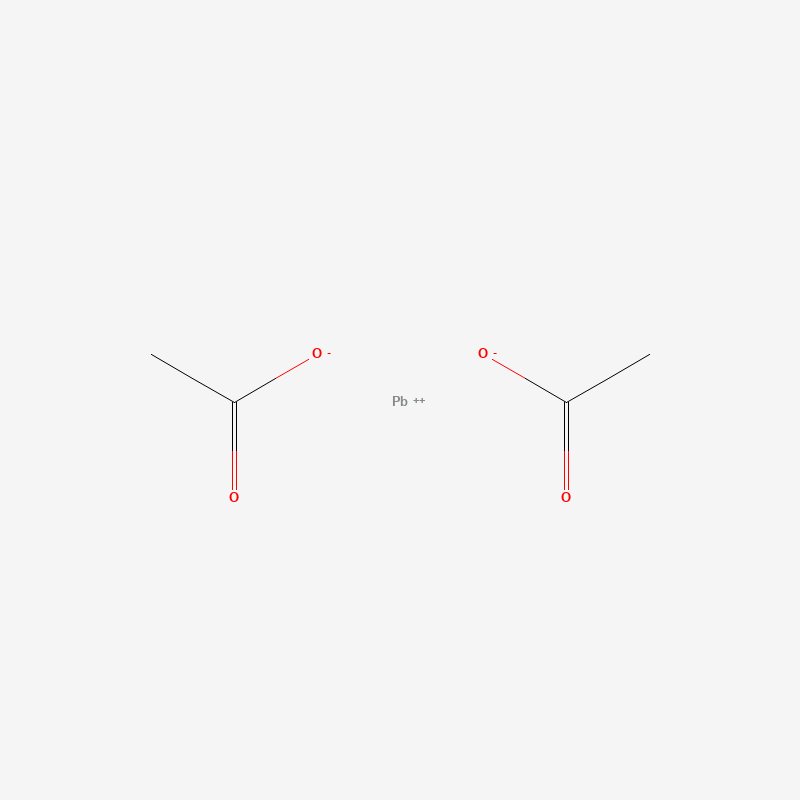
1.25×
Lead Acetate can cause cancer according to an independent committee of scientific and health experts.
lead(II) acetate Formula
- CAS Number
- 301-04-2
- Molecular formula
- C4H6O4Pb
- Molecular weight
- 325
- Exact mass
- 326.00326
- IUPAC name
- lead(2+) diacetate
- SMILES
CC(=O)[O-].CC(=O)[O-].[Pb+2]- InChI
InChI=1S/2C2H4O2.Pb/c2*1-2(3)4;/h2*1H3,(H,3,4);/q;;+2/p-2- InChIKey
GUWSLQUAAYEZAF-UHFFFAOYSA-L
Data source: Pubchem
view
lead(II) acetate Industries & Uses
Painting (Pigments, Binders, and Biocides)
Textiles (Printing, Dyeing, or Finishing)
Applying metallic patinas
lead(II) acetate Synonyms (70 total)
15347-57-6
301-04-2
Acetate de plomb
Acetate de plomb [French]
Acetic acid lead(2+) salt
Acetic acid, lead(2 +) salt
Acetic acid, lead(2+) salt
Acetic Acid Lead(II) Salt
Acetic acid, lead salt
Anhydrous lead acetate
Bleiacetat
Bleiacetat [German]
C4H6O4Pb
Caswell No. 523A
CCRIS 356
CHEBI:31767
DAA68171
DB-370629
Dibasic lead acetate
DTXCID00208948
Acetic acid lead(2+) salt (2:1)
Acetic acid, lead(2+) salt (2:1)
DTXSID6020773
EC 206-104-4
EINECS 206-104-4
EINECS 239-379-4
EPA Pesticide Chemical Code 048001
HSDB 1404
KL498O6790
L0315
L0330
Lead(2+) acetate
lead(2+) diacetate
lead(2+);diacetate
LEAD ACETATE [HSDB]
LEAD ACETATE [MI]
Lead acetate (Pb(Ac)2)
Lead acetate (Pb(O2C2H3)2)
Lead acetate [UN1616] [Poison]
LEAD ACETATE [WHO-DD]
Lead di(acetate)
Lead diacetate
Lead dibasic acetate
Lead(II) acetate
LEAD (II) ACETATE
Lead(II) Acetate [for Perovskite precursor]
MFCD00012452
Neutral lead acetate
Normal lead acetate
NS00093461
NSC 75797
NSC-75797
Pb(CH3COO)2
Plumbous acetate
plumbous;diacetate
PLUMBUM ACETICUM
PLUMBUM ACETICUM [HPUS]
RCRA waste no. U144
RCRA waste number U144
Reagecon Lead Acetate Cotton Wool according to Chinese Pharmacopoeia (ChP)
Reagecon Lead Acetate Paper according to Chinese Pharmacopoeia (ChP)
Reagecon Lead Acetate Solution according to Chinese Pharmacopoeia (ChP)
RefChem:55457
Salt of saturn
SCHEMBL56749
Sugar of lead
UN1616
Unichem PBA
UNII-KL498O6790
USP Solution Lead Acetate TS Conforms to USP
lead(II) acetate Safety & hazards
Signal wordDanger
Hazard statements
- H373 **: May causes damage to organs through prolonged or repeated exposure [Warning Specific target organ toxicity, repeated exposure]
- H400: Very toxic to aquatic life [Warning Hazardous to the aquatic environment, acute hazard]
- H410: Very toxic to aquatic life with long lasting effects [Warning Hazardous to the aquatic environment, long-term hazard]
- H351 (11.1%): Suspected of causing cancer [Warning Carcinogenicity]
- H360 (54.6%): May damage fertility or the unborn child [Danger Reproductive toxicity]
- H362 (10.4%): May cause harm to breast-fed children [Reproductive toxicity, effects on or via lactation]
- H373 (86.3%): May causes damage to organs through prolonged or repeated exposure [Warning Specific target organ toxicity, repeated exposure]
- H400 (91.4%): Very toxic to aquatic life [Warning Hazardous to the aquatic environment, acute hazard]
- H410 (91.7%): Very toxic to aquatic life with long lasting effects [Warning Hazardous to the aquatic environment, long-term hazard]
- H302 (100%): Harmful if swallowed [Warning Acute toxicity, oral]
- H332 (100%): Harmful if inhaled [Warning Acute toxicity, inhalation]
- H360 (100%): May damage fertility or the unborn child [Danger Reproductive toxicity]
- H373 (100%): May causes damage to organs through prolonged or repeated exposure [Warning Specific target organ toxicity, repeated exposure]
- H400 (100%): Very toxic to aquatic life [Warning Hazardous to the aquatic environment, acute hazard]
- H410 (100%): Very toxic to aquatic life with long lasting effects [Warning Hazardous to the aquatic environment, long-term hazard]
- H318: Causes serious eye damage [Danger Serious eye damage/eye irritation]
- H350: May cause cancer [Danger Carcinogenicity]
- H360: May damage fertility or the unborn child [Danger Reproductive toxicity]
- H362: May cause harm to breast-fed children [Reproductive toxicity, effects on or via lactation]
- H370: Causes damage to organs [Danger Specific target organ toxicity, single exposure]
- H372: Causes damage to organs through prolonged or repeated exposure [Danger Specific target organ toxicity, repeated exposure]
- H315: Causes skin irritation [Warning Skin corrosion/irritation]
- H319: Causes serious eye irritation [Warning Serious eye damage/eye irritation]
- H341: Suspected of causing genetic defects [Warning Germ cell mutagenicity]
- H351: Suspected of causing cancer [Warning Carcinogenicity]
- H332: Harmful if inhaled [Warning Acute toxicity, inhalation]
- H373: May causes damage to organs through prolonged or repeated exposure [Warning Specific target organ toxicity, repeated exposure]
Data sourced from PubChem
