lead(II) antimonate Chemical Formula
bis(antimony(5+));tris(lead(2+));octakis(oxygen(2-))
lead(II) antimonate CAS No: 13510-89-9 lead(II) antimonate Molecular formula: O8Pb3Sb2 PubChem CID: 134687277
Hazard
Danger
lead(II) antimonate Chemical Manufacturers and suppliers listings
No active product listings for lead(II) antimonate chemical yet.
lead(II) antimonate Structure
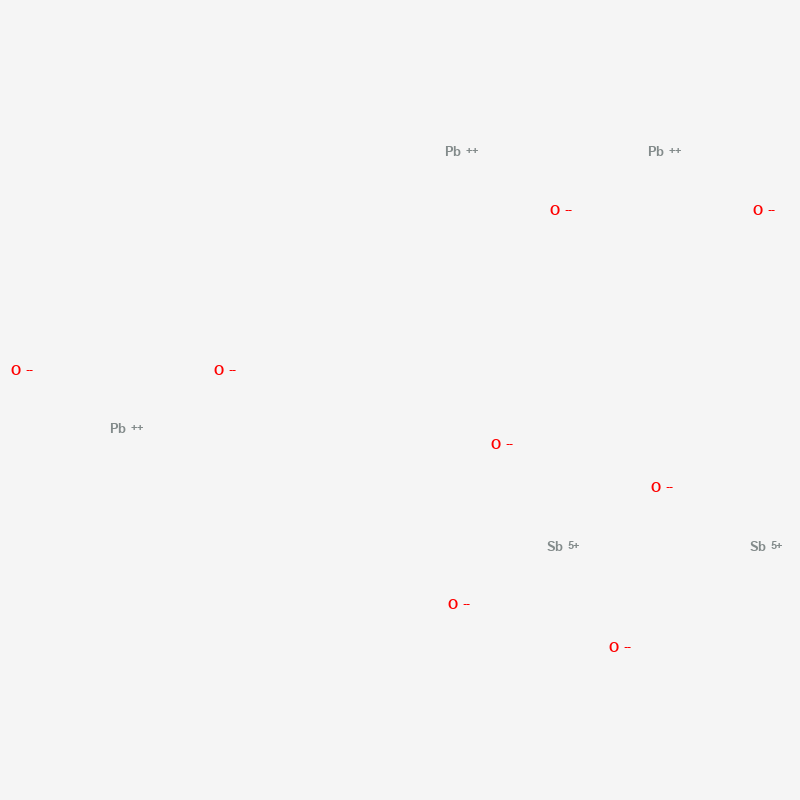
1.25×
lead(II) antimonate Formula
- CAS Number
- 13510-89-9
- Molecular formula
- O8Pb3Sb2
- Molecular weight
- 9.9e+02
- Exact mass
- 993.69511
- IUPAC name
- bis(antimony(5+));tris(lead(2+));octakis(oxygen(2-))
- SMILES
[O-2].[O-2].[O-2].[O-2].[O-2].[O-2].[O-2].[O-2].[Sb+5].[Sb+5].[Pb+2].[Pb+2].[Pb+2]- InChI
InChI=1S/8O.3Pb.2Sb/q8*-2;3*+2;2*+5- InChIKey
QVDJSOYTQRDSLZ-UHFFFAOYSA-N
Data source: Pubchem
view
lead(II) antimonate Synonyms (9 total)
13510-89-9
236-845-9
ANTIMONY LEAD OXIDE (SB2PB3O8)
Diantimony trilead octaoxide
LEAD ANTIMONATE (PB3SB2O8)
LEAD ANTIMONATE(V) (PB3SB2O8)
RefChem:113163
VHF5V54AHR
ANTIMONIC ACID (H3SBO4), LEAD(2+) SALT (2:3)
lead(II) antimonate Safety & hazards
Signal wordDanger
Hazard statements
- H302+H332 (81.5%): Harmful if swallowed or if inhaled [Warning Acute toxicity, oral; acute toxicity, inhalation]
- H302 (81.5%): Harmful if swallowed [Warning Acute toxicity, oral]
- H332 (81.5%): Harmful if inhaled [Warning Acute toxicity, inhalation]
- H373 (81.5%): May causes damage to organs through prolonged or repeated exposure [Warning Specific target organ toxicity, repeated exposure]
- H400 (81.5%): Very toxic to aquatic life [Warning Hazardous to the aquatic environment, acute hazard]
- H410 (81.5%): Very toxic to aquatic life with long lasting effects [Warning Hazardous to the aquatic environment, long-term hazard]
- H335: May cause respiratory irritation [Warning Specific target organ toxicity, single exposure; Respiratory tract irritation]
- H341: Suspected of causing genetic defects [Warning Germ cell mutagenicity]
- H350: May cause cancer [Danger Carcinogenicity]
- H361: Suspected of damaging fertility or the unborn child [Warning Reproductive toxicity]
- H372: Causes damage to organs through prolonged or repeated exposure [Danger Specific target organ toxicity, repeated exposure]
Data sourced from PubChem