lead(II) arsenite Chemical Formula
lead(2+);oxoarsinite
lead(II) arsenite CAS No: 10031-13-7 lead(II) arsenite Molecular formula: As2O4Pb PubChem CID: 197119
Hazard
Danger
lead(II) arsenite Chemical Manufacturers and suppliers listings
No active product listings for lead(II) arsenite chemical yet.
lead(II) arsenite Structure
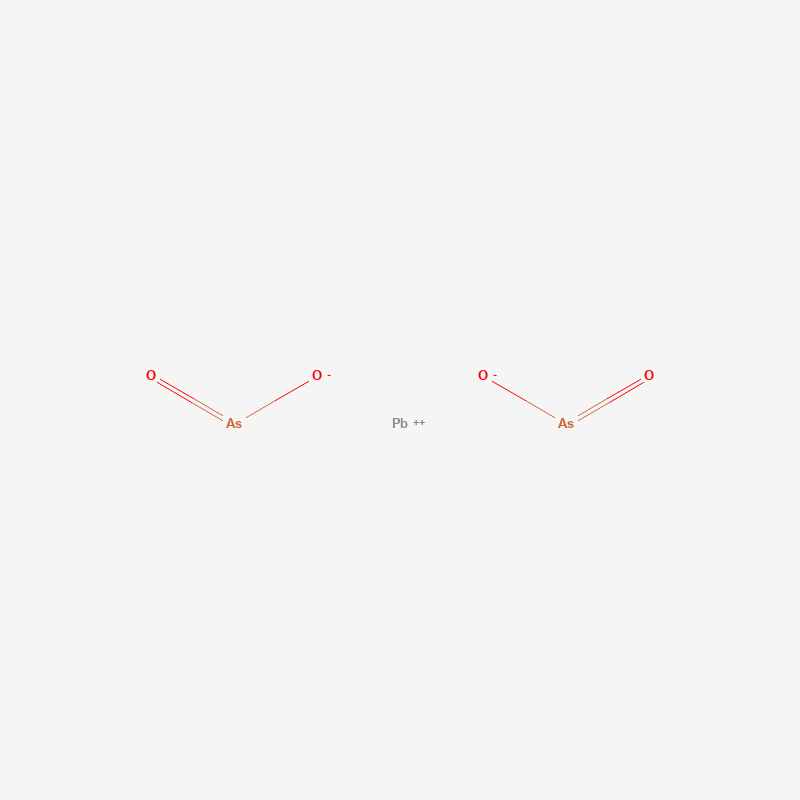
1.25×
lead(II) arsenite Formula
- CAS Number
- 10031-13-7
- Molecular formula
- As2O4Pb
- Molecular weight
- 421
- Exact mass
- 421.79950
- IUPAC name
- lead(2+);oxoarsinite
- SMILES
[O-][As]=O.[O-][As]=O.[Pb+2]- InChI
InChI=1S/2AsHO2.Pb/c2*2-1-3;/h2*(H,2,3);/q;;+2/p-2- InChIKey
JFOKPVUWYKONLQ-UHFFFAOYSA-L
Data source: Pubchem
view
lead(II) arsenite Industries & Uses
Farming (Pesticides)
lead(II) arsenite Synonyms (22 total)
10031-13-7
67IKE0746A
ARSENIOUS ACID LEAD(2+) SALT
Arsenious acid lead salt
ARSENOUS ACID LEAD(2+) SALT
bis(arsorosooxy)plumbane
DTXCID701326567
DTXSID70897141
EINECS 233-083-9
JFOKPVUWYKONLQ-UHFFFAOYSA-L
lead(2+);oxoarsinite
Lead arsenite
LEAD ARSENITE [MI]
Lead arsenite (Pb(AsO2)2)
Lead(II) arsenite
LEAD METAARSENITE
NS00075514
Q27264139
RefChem:152618
UN1618
Arsenenous acid, lead(2+) salt
UNII-67IKE0746A
lead(II) arsenite Safety & hazards
Signal wordDanger
Hazard statements
- H319: Causes serious eye irritation [Warning Serious eye damage/eye irritation]
- H350: May cause cancer [Danger Carcinogenicity]
- H361: Suspected of damaging fertility or the unborn child [Warning Reproductive toxicity]
- H370: Causes damage to organs [Danger Specific target organ toxicity, single exposure]
- H372: Causes damage to organs through prolonged or repeated exposure [Danger Specific target organ toxicity, repeated exposure]
- H316: Causes mild skin irritation [Warning Skin corrosion/irritation]
- H320: Causes eye irritation [Warning Serious eye damage/eye irritation]
- H335: May cause respiratory irritation [Warning Specific target organ toxicity, single exposure; Respiratory tract irritation]
- H341: Suspected of causing genetic defects [Warning Germ cell mutagenicity]
- H360: May damage fertility or the unborn child [Danger Reproductive toxicity]
- H371: May cause damage to organs [Warning Specific target organ toxicity, single exposure]
- H373: May causes damage to organs through prolonged or repeated exposure [Warning Specific target organ toxicity, repeated exposure]
Data sourced from PubChem
