lead(II) chloride Chemical Formula
dichlorolead
lead(II) chloride CAS No: 7758-95-4 lead(II) chloride Molecular formula: Cl2Pb PubChem CID: 24459
Hazard
Danger
lead(II) chloride Chemical Manufacturers and suppliers listings
No active product listings for lead(II) chloride chemical yet.
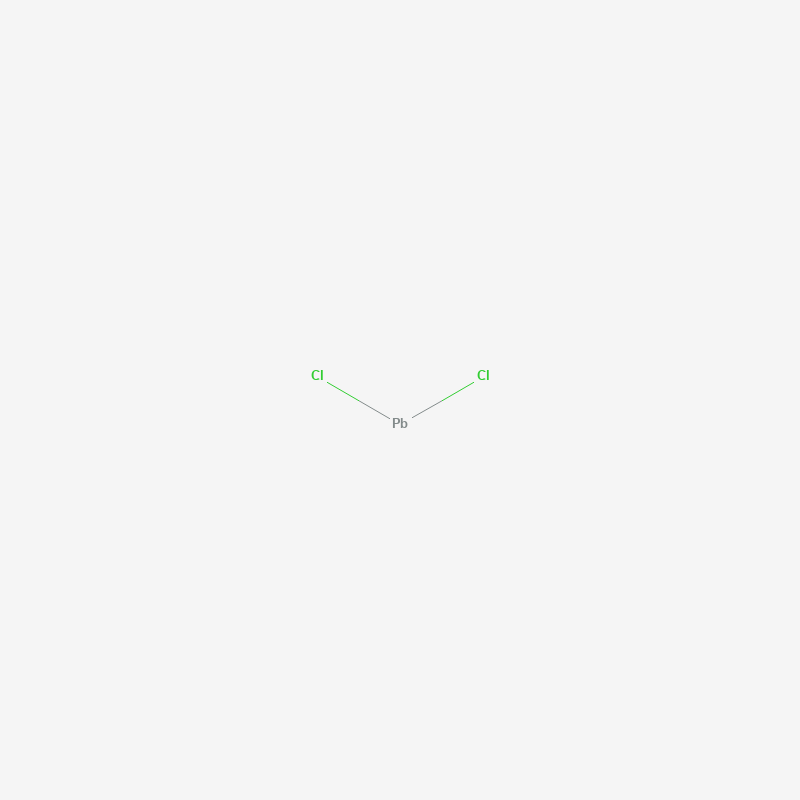
lead(II) chloride Structure
1.25×
Lead(II) chloride is an inorganic chloride consisting of two chlorine atoms covalently bound to a central lead atom. It is an inorganic chloride and a lead coordination entity.
lead(II) chloride Formula
- CAS Number
- 7758-95-4
- Molecular formula
- Cl2Pb
- Molecular weight
- 278
- Exact mass
- 277.91436
- IUPAC name
- dichlorolead
- SMILES
Cl[Pb]Cl- InChI
InChI=1S/2ClH.Pb/h2*1H;/q;;+2/p-2- InChIKey
HWSZZLVAJGOAAY-UHFFFAOYSA-L
Data source: Pubchem
view
lead(II) chloride Industries & Uses
Steel Producing
Battery Manufacturing
Painting (Pigments, Binders, and Biocides)
lead(II) chloride Synonyms (36 total)
231-845-5
4IL61GN3YI
7758-95-4
AKOS015833815
Bleichlorid
CHEBI:88212
Cl2Pb
dichloro-lambda(2)-plumbane
dichlorolead
dichloroplumbane
DTXCID9021059
DTXSID1041059
Lead(2+) chloride
lead(2+) dichloride
lead(2+);dichloride
LEAD CHLORIDE
Lead chloride (PbCl2)
Lead dichloride
Lead (II) chloride
Lead(II) chloride
Lead(II) chloride, 99.999% (metals basis)
Lead(II) chloride, 99.999% trace metals basis
Lead(II) chloride, anhydrous, beads, -10 mesh, 99.999%
Lead(II) chloride anhyrous
Lead(II) chloride, p.a., 99.0%
Lead(II) chloride, powder, 98%
Lead(II) chloride, Reagent Grade
Lead(II) chloride, ultra dry
MFCD00011157
NS00081405
PbCl2
Plumbous chloride
Q411848
RefChem:5939
SCHEMBL24664
SY026132
lead(II) chloride Safety & hazards
Signal wordDanger
Hazard statements
- H302+H332 (64.2%): Harmful if swallowed or if inhaled [Warning Acute toxicity, oral; acute toxicity, inhalation]
- H302 (99.4%): Harmful if swallowed [Warning Acute toxicity, oral]
- H332 (99.4%): Harmful if inhaled [Warning Acute toxicity, inhalation]
- H351 (67.3%): Suspected of causing cancer [Warning Carcinogenicity]
- H360 (35.8%): May damage fertility or the unborn child [Danger Reproductive toxicity]
- H362 (65.4%): May cause harm to breast-fed children [Reproductive toxicity, effects on or via lactation]
- H372 (67.9%): Causes damage to organs through prolonged or repeated exposure [Danger Specific target organ toxicity, repeated exposure]
- H373 (32.7%): May causes damage to organs through prolonged or repeated exposure [Warning Specific target organ toxicity, repeated exposure]
- H400 (96.9%): Very toxic to aquatic life [Warning Hazardous to the aquatic environment, acute hazard]
- H410 (100%): Very toxic to aquatic life with long lasting effects [Warning Hazardous to the aquatic environment, long-term hazard]
- H302: Harmful if swallowed [Warning Acute toxicity, oral]
- H350: May cause cancer [Danger Carcinogenicity]
- H360: May damage fertility or the unborn child [Danger Reproductive toxicity]
- H362: May cause harm to breast-fed children [Reproductive toxicity, effects on or via lactation]
- H370: Causes damage to organs [Danger Specific target organ toxicity, single exposure]
- H372: Causes damage to organs through prolonged or repeated exposure [Danger Specific target organ toxicity, repeated exposure]
- H318: Causes serious eye damage [Danger Serious eye damage/eye irritation]
- H351: Suspected of causing cancer [Warning Carcinogenicity]
- H332: Harmful if inhaled [Warning Acute toxicity, inhalation]
- H341: Suspected of causing genetic defects [Warning Germ cell mutagenicity]
Data sourced from PubChem