lead(II) phosphate Chemical Formula
tris(lead(2+)) diphosphate
lead(II) phosphate CAS No: 7446-27-7 lead(II) phosphate Molecular formula: O8P2Pb3 PubChem CID: 24009
Hazard
Danger
lead(II) phosphate Chemical Manufacturers and suppliers listings
No active product listings for lead(II) phosphate chemical yet.
lead(II) phosphate Structure
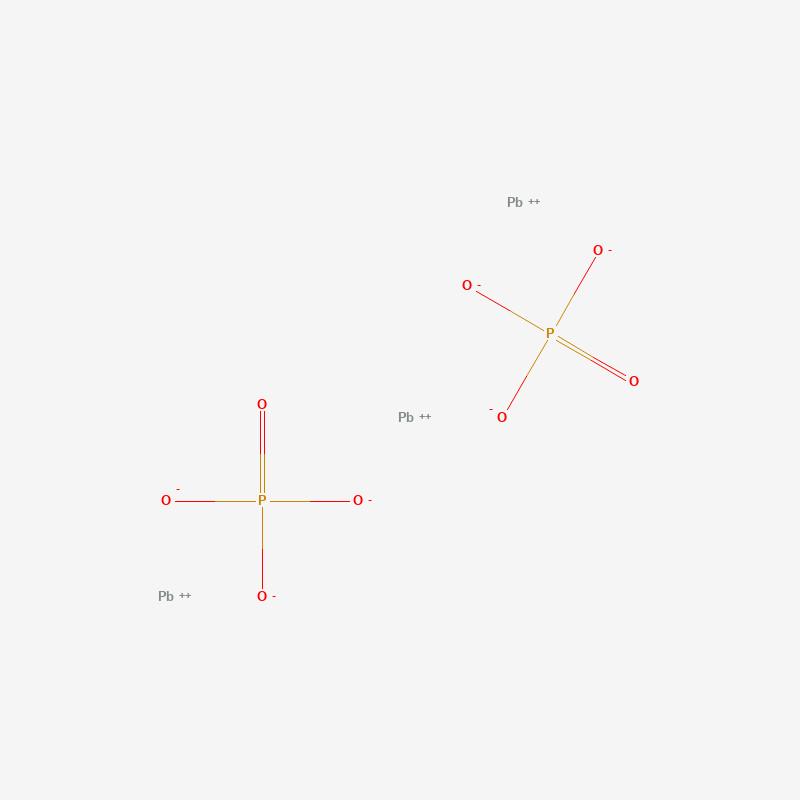
1.25×
Lead Phosphate can cause cancer according to an independent committee of scientific and health experts.
lead(II) phosphate Formula
- CAS Number
- 7446-27-7
- Molecular formula
- O8P2Pb3
- Molecular weight
- 8.1e+02
- Exact mass
- 811.83461
- IUPAC name
- tris(lead(2+)) diphosphate
- SMILES
[O-]P(=O)([O-])[O-].[O-]P(=O)([O-])[O-].[Pb+2].[Pb+2].[Pb+2]- InChI
InChI=1S/2H3O4P.3Pb/c2*1-5(2,3)4;;;/h2*(H3,1,2,3,4);;;/q;;3*+2/p-6- InChIKey
HUTDDBSSHVOYJR-UHFFFAOYSA-H
Data source: Pubchem
view
lead(II) phosphate Industries & Uses
Plastic Composites Manufacturing
Glass Manufacturing
lead(II) phosphate Synonyms (42 total)
231-205-5
62I1T06190
7446-27-7
Bleiphosphat
Bleiphosphat [German]
CCRIS 360
C.I. 77622
CI 77622
Collodial lead phosphate
DTXSID5064706
EINECS 231-205-5
HSDB 2637
HUTDDBSSHVOYJR-UHFFFAOYSA-H
Lead(2+) phosphate
Lead(2+) phosphate (Pb3(PO4)2)
LEAD DIPHOSPHATE
LEAD (II) O-PHOSPHATE
Lead(II) phosphate
Lead(II) phosphate (3:2)
Lead orthophosphate
LEAD PHOSPHATE
Lead phosphate (3:2)
Lead phosphate, colloidal
LEAD PHOSPHATE [HSDB]
LEAD PHOSPHATE [MI]
Lead phosphate (Pb3(PO4)2)
Normal lead orthophosphate
NS00112611
Perlex paste 500
Perlex paste 600A
Phosphoric acid, lead(2+) salt (2:3)
PHOSPHORIC ACID LEAD(2+) SALT (2:3)
Phosphoric acid, lead salt
Plumbous phosphate
RCRA waste no. U145
RCRA waste number U145
RefChem:152650
SCHEMBL76241
Trilead bis(orthophosphate)
Trilead phosphate
tris(lambda2-lead(2+) ion) diphosphate
UNII-62I1T06190
lead(II) phosphate Safety & hazards
Signal wordDanger
Hazard statements
- H373 **: May causes damage to organs through prolonged or repeated exposure [Warning Specific target organ toxicity, repeated exposure]
- H400: Very toxic to aquatic life [Warning Hazardous to the aquatic environment, acute hazard]
- H410: Very toxic to aquatic life with long lasting effects [Warning Hazardous to the aquatic environment, long-term hazard]
- H351: Suspected of causing cancer [Warning Carcinogenicity]
- H360: May damage fertility or the unborn child [Danger Reproductive toxicity]
- H370: Causes damage to organs [Danger Specific target organ toxicity, single exposure]
- H372: Causes damage to organs through prolonged or repeated exposure [Danger Specific target organ toxicity, repeated exposure]
- H341: Suspected of causing genetic defects [Warning Germ cell mutagenicity]
- H373: May causes damage to organs through prolonged or repeated exposure [Warning Specific target organ toxicity, repeated exposure]
Data sourced from PubChem