lead(II) stearate Chemical Formula
lead(2+);bis(octadecanoate)
lead(II) stearate CAS No: 1072-35-1 lead(II) stearate Molecular formula: C36H70O4Pb PubChem CID: 61258
Hazard
Danger
lead(II) stearate Chemical Manufacturers and suppliers listings
No active product listings for lead(II) stearate chemical yet.
lead(II) stearate Structure
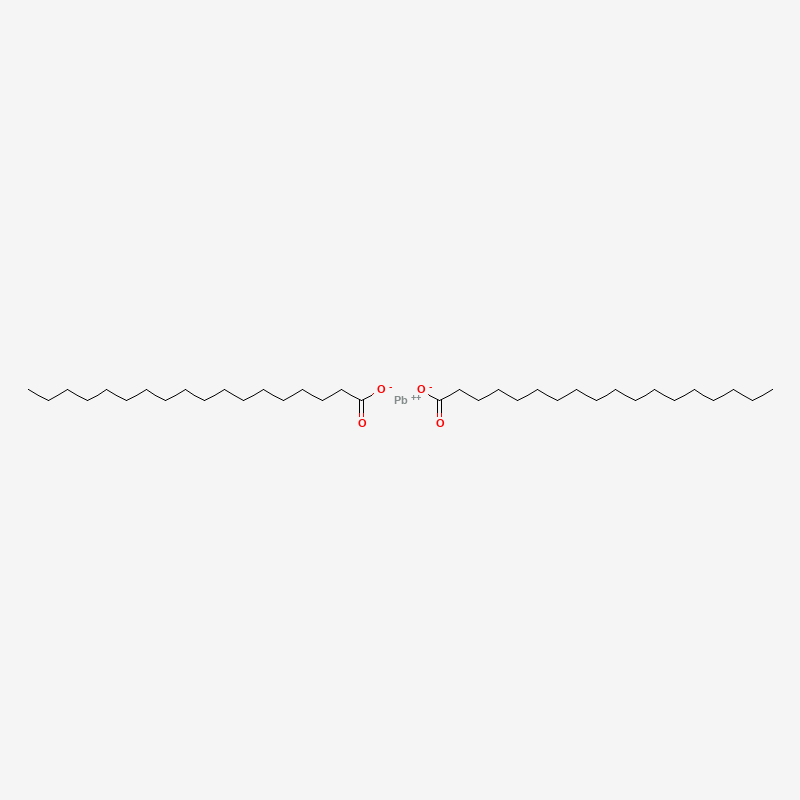
1.25×
lead(II) stearate Formula
- CAS Number
- 1072-35-1
- Molecular formula
- C36H70O4Pb
- Molecular weight
- 774
- Exact mass
- 774.50406
- IUPAC name
- lead(2+);bis(octadecanoate)
- SMILES
CCCCCCCCCCCCCCCCCC(=O)[O-].CCCCCCCCCCCCCCCCCC(=O)[O-].[Pb+2]- InChI
InChI=1S/2C18H36O2.Pb/c2*1-2-3-4-5-6-7-8-9-10-11-12-13-14-15-16-17-18(19)20;/h2*2-17H2,1H3,(H,19,20);/q;;+2/p-2- InChIKey
UQLDLKMNUJERMK-UHFFFAOYSA-L
Data source: Pubchem
view
lead(II) stearate Synonyms (53 total)
1072-35-1
214-005-2
291-696-7
5002G
90459-52-2
AKOS015839879
Austrostab 110E
BAA07235
C36H70O4Pb
DTXCID701765652
DTXSID0029630
DTXSID501066618
EINECS 214-005-2
EINECS 291-696-7
HQ5TZ3NAEI
lead(2+) dioctadecanoate
lead(2+);octadecanoate
Lead(2+) octadecanoate
Lead(2+) stearate
Lead distearate
1072-35-17428-48-056189-09-452652-59-2(replacedby56189-09-4)
Lead distearate, pure
Lead(II) octadecanoate
Lead(II) octadecaoate
Lead (II) stearate
Lead(II) stearate
LEAD STEARATE
LEAD STEARATE [MI]
Lead stearic acid
Listab 28
Listab 28ND
MFCD00050719
NC 18ED
neutral lead stearate
NS00079554
NS 2
Octadecanoic acid, lead(2+) salt
Octadecanoic acid, lead(2+) salt (2:1)
OCTADECANOIC ACID LEAD(2+) SALT (2:1)
Octadecanoic acid, lead(2+) salt, basic
Octadecanoic acid, lead salt
(octadecanoyloxy)plumbyl octadecanoate
PBST
plumbous;octadecanoate
RefChem:798764
SCHEMBL141820
SL 1000
SL 1000 (stabilizer)
SLW
Stabinex NC18
Stearic acid, lead(2+) salt
STEARIC ACID LEAD SALT
UNII-HQ5TZ3NAEI
lead(II) stearate Safety & hazards
Signal wordDanger
Hazard statements
- H302 (100%): Harmful if swallowed [Warning Acute toxicity, oral]
- H332 (100%): Harmful if inhaled [Warning Acute toxicity, inhalation]
- H360 (100%): May damage fertility or the unborn child [Danger Reproductive toxicity]
- H373 (100%): May causes damage to organs through prolonged or repeated exposure [Warning Specific target organ toxicity, repeated exposure]
- H400 (100%): Very toxic to aquatic life [Warning Hazardous to the aquatic environment, acute hazard]
- H410 (100%): Very toxic to aquatic life with long lasting effects [Warning Hazardous to the aquatic environment, long-term hazard]
- H351: Suspected of causing cancer [Warning Carcinogenicity]
- H360: May damage fertility or the unborn child [Danger Reproductive toxicity]
- H362: May cause harm to breast-fed children [Reproductive toxicity, effects on or via lactation]
- H370: Causes damage to organs [Danger Specific target organ toxicity, single exposure]
- H372: Causes damage to organs through prolonged or repeated exposure [Danger Specific target organ toxicity, repeated exposure]
- H350: May cause cancer [Danger Carcinogenicity]
- H302: Harmful if swallowed [Warning Acute toxicity, oral]
- H332: Harmful if inhaled [Warning Acute toxicity, inhalation]
- H341: Suspected of causing genetic defects [Warning Germ cell mutagenicity]
- H373: May causes damage to organs through prolonged or repeated exposure [Warning Specific target organ toxicity, repeated exposure]
Data sourced from PubChem
