lead(II) thiocyanate Chemical Formula
lead(2+) dithiocyanate
lead(II) thiocyanate CAS No: 592-87-0 lead(II) thiocyanate Molecular formula: C2N2PbS2 PubChem CID: 11616
Hazard
Danger
lead(II) thiocyanate Chemical Manufacturers and suppliers listings
No active product listings for lead(II) thiocyanate chemical yet.
lead(II) thiocyanate Structure
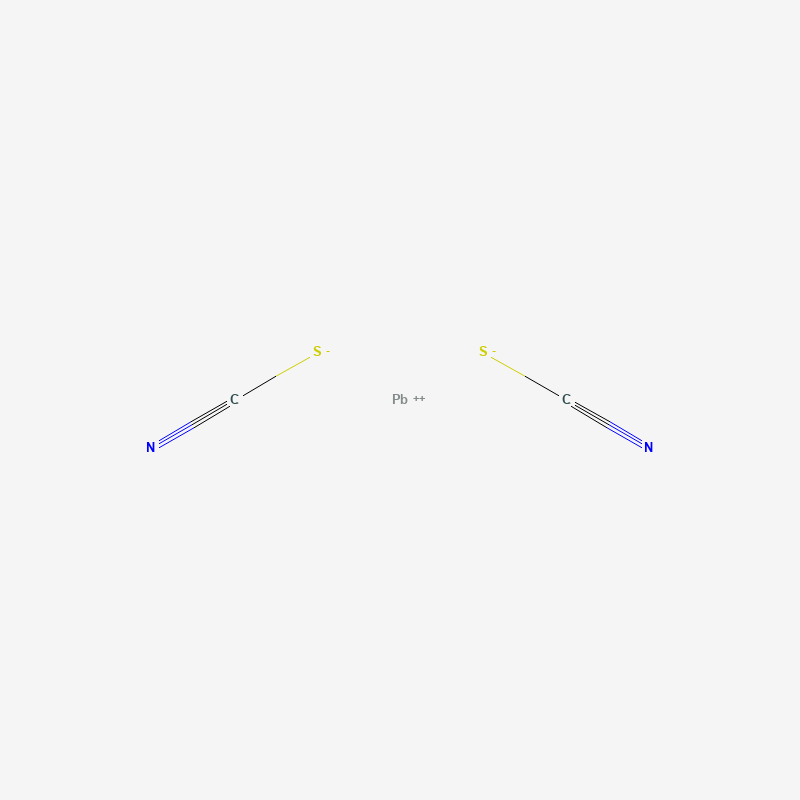
1.25×
lead(II) thiocyanate Formula
- CAS Number
- 592-87-0
- Molecular formula
- C2N2PbS2
- Molecular weight
- 323
- Exact mass
- 323.92694
- IUPAC name
- lead(2+) dithiocyanate
- SMILES
C(#N)[S-].C(#N)[S-].[Pb+2]- InChI
InChI=1S/2CHNS.Pb/c2*2-1-3;/h2*3H;/q;;+2/p-2- InChIKey
VRNINGUKUJWZTH-UHFFFAOYSA-L
Data source: Pubchem
view
lead(II) thiocyanate Synonyms (31 total)
209-774-6
7977FZ765Q
bis(cyanosulfanyl)plumbane
C2N2PbS2
DTXCID101326569
DTXSID90890513
lead(2+);dithiocyanate
LEAD(2+) THIOCYANATE
LEAD BIS(THIOCYANATE)
Lead dithiocyanate
Lead(II) thiocyanate
Lead(II) thiocyanate (Pb(NCS)2)
Lead isothiocyanate
Lead sulfocyanate
LEAD THIOCYANATE
LEAD THIOCYANATE [MI]
Lead thiocyanate (Pb(SCN)2)
MFCD00011155
NS00075548
Pb (N C S)2
F862826
Isothiocyanic acid, lead(2+) salt
L0365
plumbous;dithiocyanate
RefChem:798775
SCHEMBL107555
SCHEMBL1274475
SCHEMBL42006
SY110143
Thiocyanic acid, lead(2+) salt
Thiocyanic acid lead(2+) salt (2:1)
lead(II) thiocyanate Safety & hazards
Signal wordDanger
Hazard statements
- H302 (97.8%): Harmful if swallowed [Warning Acute toxicity, oral]
- H312 (97.8%): Harmful in contact with skin [Warning Acute toxicity, dermal]
- H332 (97.8%): Harmful if inhaled [Warning Acute toxicity, inhalation]
- H360 (97.8%): May damage fertility or the unborn child [Danger Reproductive toxicity]
- H373 (100%): May causes damage to organs through prolonged or repeated exposure [Warning Specific target organ toxicity, repeated exposure]
- H400 (100%): Very toxic to aquatic life [Warning Hazardous to the aquatic environment, acute hazard]
- H410 (100%): Very toxic to aquatic life with long lasting effects [Warning Hazardous to the aquatic environment, long-term hazard]
- H302: Harmful if swallowed [Warning Acute toxicity, oral]
- H312: Harmful in contact with skin [Warning Acute toxicity, dermal]
- H332: Harmful if inhaled [Warning Acute toxicity, inhalation]
- H341: Suspected of causing genetic defects [Warning Germ cell mutagenicity]
- H351: Suspected of causing cancer [Warning Carcinogenicity]
- H373: May causes damage to organs through prolonged or repeated exposure [Warning Specific target organ toxicity, repeated exposure]
Data sourced from PubChem
