lead(III) acetate Chemical Formula
lead(2+) tetraacetate
lead(III) acetate CAS No: 546-67-8 lead(III) acetate Molecular formula: C8H12O8Pb-2 PubChem CID: 11025
Hazard
Danger
lead(III) acetate Chemical Manufacturers and suppliers listings
No active product listings for lead(III) acetate chemical yet.
lead(III) acetate Structure
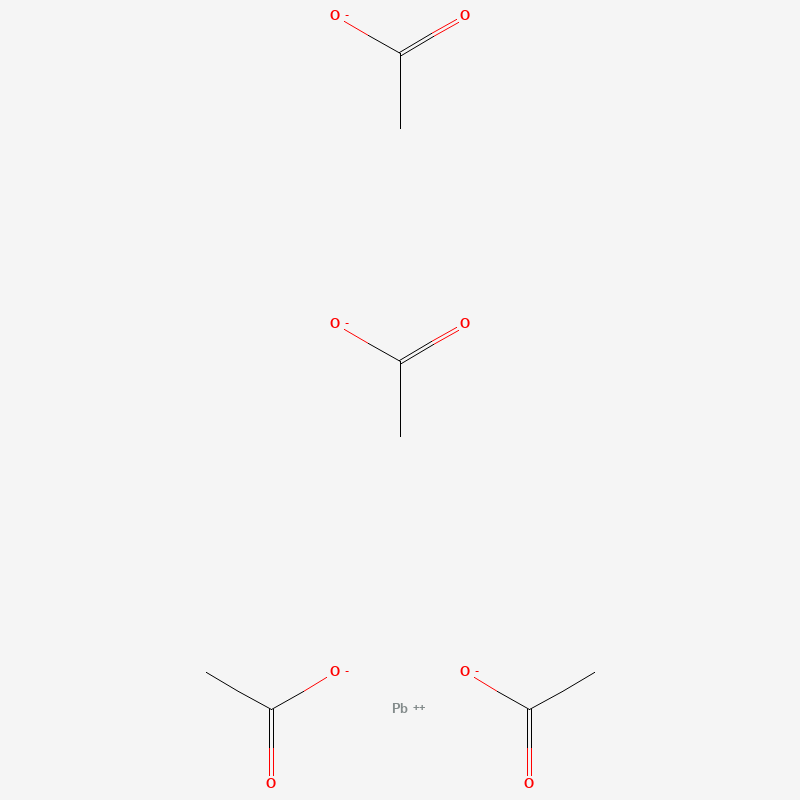
1.25×
lead(III) acetate Formula
- CAS Number
- 546-67-8
- Molecular formula
- C8H12O8Pb-2
- Molecular weight
- 443
- Exact mass
- 444.02987
- IUPAC name
- lead(2+) tetraacetate
- SMILES
CC(=O)[O-].CC(=O)[O-].CC(=O)[O-].CC(=O)[O-].[Pb+2]- InChI
InChI=1S/4C2H4O2.Pb/c4*1-2(3)4;/h4*1H3,(H,3,4);/q;;;;+2/p-4- InChIKey
ACKFDYCQCBEDNU-UHFFFAOYSA-J
Data source: Pubchem
view
lead(III) acetate Synonyms (31 total)
208-908-0
546-67-8
Acetic acid, lead(4+) salt
AKOS015904608
C8H12O8Pb-2
CFN24B03DB
CHEBI:77245
DTXSID6041058
EC 208-908-0
EINECS 208-908-0
HSDB 640
lead(2+);tetraacetate
lead(4+) tetraacetate
Lead acetate (Pb(O2C2H3)4)
Lead acetate (Pb(OAc)4)
Lead acetate, tetra-
Lead(IV) acetate
Lead(IV)acetate
Lead (IV) Acetate
LEAD TETRAACETATE
Acetic acid lead(4+) salt (4:1)
Acetic acid, lead(4+) salt (4:1)
lambda2-lead(2+) ion tetraacetate
LEAD TETRAACETATE [HSDB]
LEAD TETRAACETATE [MI]
Lead tetracetate
Plumbic acetate
plumbous;tetraacetate
RefChem:152659
SCHEMBL29459632
UNII-CFN24B03DB
lead(III) acetate Safety & hazards
Signal wordDanger
Hazard statements
- H302+H332 (59.3%): Harmful if swallowed or if inhaled [Warning Acute toxicity, oral; acute toxicity, inhalation]
- H302 (97.7%): Harmful if swallowed [Warning Acute toxicity, oral]
- H332 (97.7%): Harmful if inhaled [Warning Acute toxicity, inhalation]
- H360 (40.7%): May damage fertility or the unborn child [Danger Reproductive toxicity]
- H373 (98.9%): May causes damage to organs through prolonged or repeated exposure [Warning Specific target organ toxicity, repeated exposure]
- H400 (98.9%): Very toxic to aquatic life [Warning Hazardous to the aquatic environment, acute hazard]
- H410 (99.4%): Very toxic to aquatic life with long lasting effects [Warning Hazardous to the aquatic environment, long-term hazard]
- H302: Harmful if swallowed [Warning Acute toxicity, oral]
- H332: Harmful if inhaled [Warning Acute toxicity, inhalation]
- H341: Suspected of causing genetic defects [Warning Germ cell mutagenicity]
- H351: Suspected of causing cancer [Warning Carcinogenicity]
- H373: May causes damage to organs through prolonged or repeated exposure [Warning Specific target organ toxicity, repeated exposure]
Data sourced from PubChem