lithium carbonate Chemical Formula
dilithium;carbonate
lithium carbonate CAS No: 554-13-2 lithium carbonate Molecular formula: CLi2O3 PubChem CID: 11125
Hazard
Danger
lithium carbonate Chemical Manufacturers and suppliers listings
No active product listings for lithium carbonate chemical yet.
lithium carbonate Structure
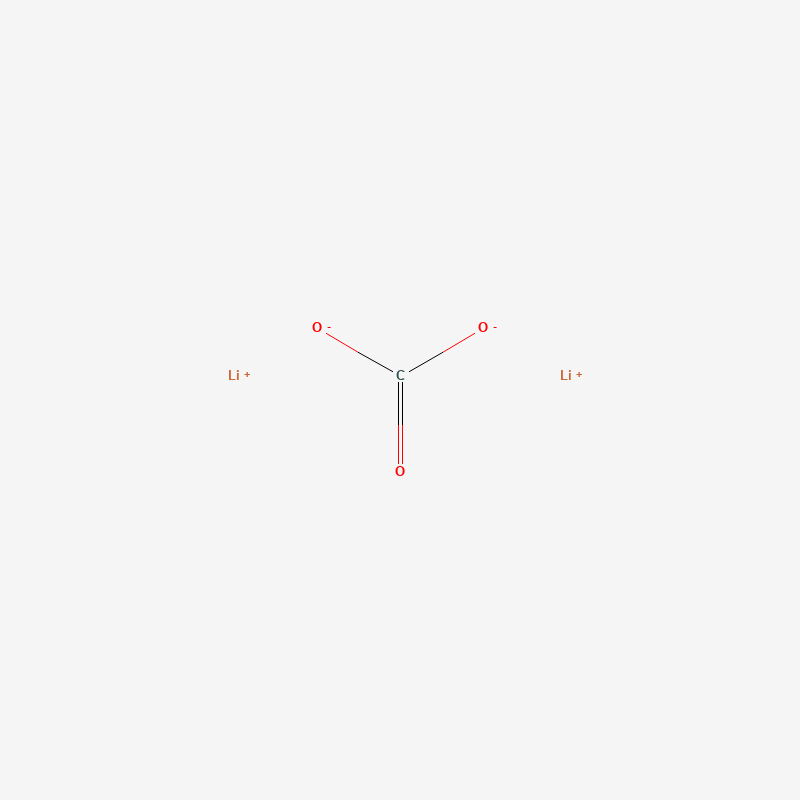
1.25×
Lithium Carbonate can cause developmental toxicity according to state or federal government labeling requirements.
lithium carbonate Formula
- CAS Number
- 554-13-2
- Molecular formula
- CLi2O3
- Molecular weight
- 73.9
- Exact mass
- 74.01675073
- IUPAC name
- dilithium;carbonate
- SMILES
[Li+].[Li+].C(=O)([O-])[O-]- InChI
InChI=1S/CH2O3.2Li/c2-1(3)4;;/h(H2,2,3,4);;/q;2*+1/p-2- InChIKey
XGZVUEUWXADBQD-UHFFFAOYSA-L
Data source: Pubchem
view
lithium carbonate Industries & Uses
Aluminum Producing
Painting (Pigments, Binders, and Biocides)
Cement Producing
Welding Over Coatings
Glass Manufacturing
lithium carbonate Synonyms (130 total)
209-062-5
2BMD2GNA4V
554-13-2
AKOS015904647
Bicarbonate, Lithium
C07964
Camcolit
Camcolit 250
Camcolit 400
Candamide
Carbolith
Carbolithium
Carbolithium IFI
Carbolitium
Carbonate, Dilithium
Carbonate, Lithium
Carbonic acid, dilithium salt
Carbonic acid lithium salt
CCRIS 3153
Ceglution
Carbonic acid, lithium salt (1:2)
Carbonic acid lithium salt (Li2CO3)
CHEBI:6504
CHEMBL1200826
CLi2O3
CP 15,467 61
CP 15467-61
CP-15,467-61
CP-15467-61
CP-1546761
CP15,46761
D00801
DB14509
dilithium;carbonate
Dilithium carbonate
DILITHIUM CARBONATE [WHO-IP]
dilithium trioxidocarbonate
DTXCID703784
DTXSID1023784
EBC-151185
EC 209-062-5
EINECS 209-062-5
Escalith
Eskalith
Eskalith CR
Eskalith (TN)
Eutimin
F567842
FL11820
HSDB 3351
Hypnorex
L0224
Li2 (C O3)
Li2CO3
Limas
Liskonum
Litard
Lithane
Lithea
Lithicarb
Lithii carbonas
LITHII CARBONAS [WHO-IP LATIN]
Lithinate
Lithionate
Lithium Carb
LITHIUM CARBONATE
Lithium carbonate (2:1)
Lithium carbonate, ACS reagent grade
LITHIUM CARBONATE [EP MONOGRAPH]
Lithium Carbonate ER
Lithium Carbonate Extended-Release Tablet
LITHIUM CARBONATE [HSDB]
LITHIUM CARBONATE [JAN]
Lithium carbonate (JP18/USP)
Lithium carbonate (Li2CO3)
LITHIUM CARBONATE LITHIUM CARBONATE
LITHIUM CARBONATE [MART.]
LITHIUM CARBONATE [MI]
LITHIUM CARBONATE [ORANGE BOOK]
LITHIUM CARBONATE [USAN]
Lithium carbonate [USAN:USP:JAN]
LITHIUM CARBONATE [USP MONOGRAPH]
LITHIUM CARBONATE [USP-RS]
LITHIUM CARBONATE [VANDF]
LITHIUM CARBONATE [WHO-DD]
LITHIUM CARBONATE [WHO-IP]
Lithium carbonicum
Lithium carbonicum 3X
LITHIUM CARBONICUM [HPUS]
Lithium Phasal
Lithium QD
Lithizine
Lithobid
Lithobid (TN)
Litho-Carb
Lithotabs
Liticar
Manialith
Maniprex
MFCD00011084
Micalith
Neurolepsin
NS00076179
NSC 16895
NSC-16895
NSC16895
orb2655489
orb3141376
orb3177809
Pfi-lithium
Pfl-Lithium
Phasal
Plenur
Priadel
Q410174
Quilinorm retard
Quilinormretard
Quilonum retard
R00334
RefChem:5955
RHEUMATSM
s4933
SCHEMBL25389
starbld0023766
STR02638
T8131
Teralithe
Teralithe [French]
UNII-2BMD2GNA4V
Z608344424
lithium carbonate Safety & hazards
Signal wordDanger
Hazard statements
- H302 (99.8%): Harmful if swallowed [Warning Acute toxicity, oral]
- H315 (36.8%): Causes skin irritation [Warning Skin corrosion/irritation]
- H318 (36.6%): Causes serious eye damage [Danger Serious eye damage/eye irritation]
- H319 (63.1%): Causes serious eye irritation [Warning Serious eye damage/eye irritation]
- H335 (36.6%): May cause respiratory irritation [Warning Specific target organ toxicity, single exposure; Respiratory tract irritation]
- H360 (37.1%): May damage fertility or the unborn child [Danger Reproductive toxicity]
- H372 (36.1%): Causes damage to organs through prolonged or repeated exposure [Danger Specific target organ toxicity, repeated exposure]
- H302: Harmful if swallowed [Warning Acute toxicity, oral]
- H320: Causes eye irritation [Warning Serious eye damage/eye irritation]
- H336: May cause drowsiness or dizziness [Warning Specific target organ toxicity, single exposure; Narcotic effects]
- H360: May damage fertility or the unborn child [Danger Reproductive toxicity]
- H362: May cause harm to breast-fed children [Reproductive toxicity, effects on or via lactation]
- H370: Causes damage to organs [Danger Specific target organ toxicity, single exposure]
- H372: Causes damage to organs through prolonged or repeated exposure [Danger Specific target organ toxicity, repeated exposure]
- H402: Harmful to aquatic life [Hazardous to the aquatic environment, acute hazard]
- H412: Harmful to aquatic life with long lasting effects [Hazardous to the aquatic environment, long-term hazard]
- H335: May cause respiratory irritation [Warning Specific target organ toxicity, single exposure; Respiratory tract irritation]
- H319: Causes serious eye irritation [Warning Serious eye damage/eye irritation]
Data sourced from PubChem
