lithium hexafluorophosphate Chemical Formula
lithium hexafluorophosphate
lithium hexafluorophosphate CAS No: 21324-40-3 lithium hexafluorophosphate Molecular formula: F6LiP PubChem CID: 23688915
Hazard
Danger
lithium hexafluorophosphate Chemical Manufacturers and suppliers listings
No active product listings for lithium hexafluorophosphate chemical yet.
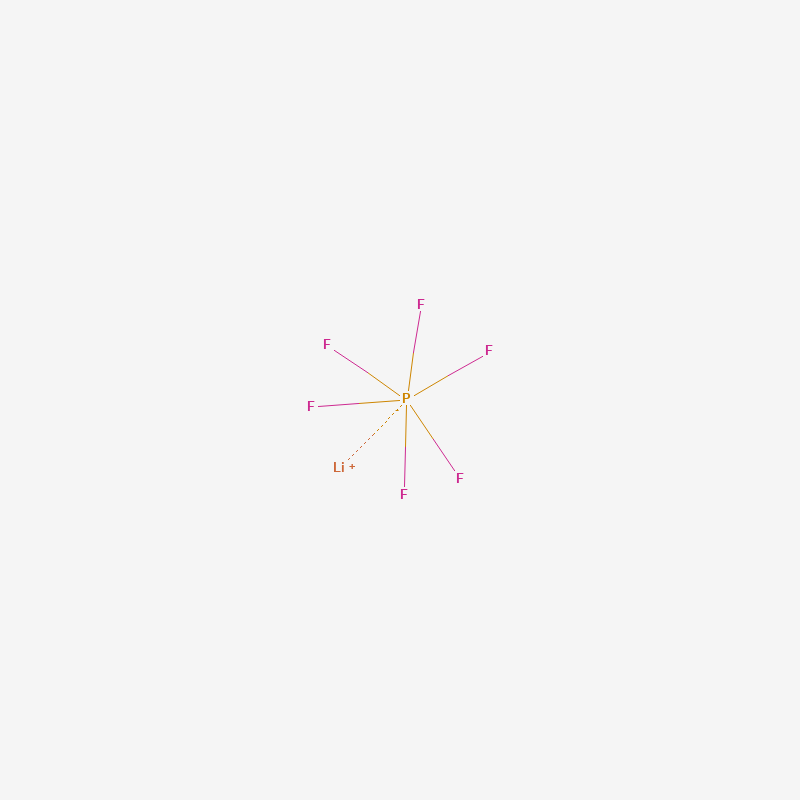
lithium hexafluorophosphate Structure
1.25×
Lithium hexafluorophosphate is an inorganic lithium salt having hexafluorophosphate(1) as the counterion. It is an electrolyte used in lithium-ion batteries. It contains a hexafluorophosphate(1-).
lithium hexafluorophosphate Formula
- CAS Number
- 21324-40-3
- Molecular formula
- F6LiP
- Molecular weight
- 151.9
- Exact mass
- 151.98018440
- IUPAC name
- lithium hexafluorophosphate
- SMILES
[Li+].F[P-](F)(F)(F)(F)F- InChI
InChI=1S/F6P.Li/c1-7(2,3,4,5)6;/q-1;+1- InChIKey
AXPLOJNSKRXQPA-UHFFFAOYSA-N
Data source: Pubchem
view
lithium hexafluorophosphate Synonyms (42 total)
EINECS 244-334-7
hexafluorophosphate lithium salt
Lithium hexafluoridophosphate(1-)
lithium,hexafluorophosphate
lithium;hexafluorophosphate
Lithium hexafluorophosphate
Lithium hexafluorophosphate(1-)
Lithium hexafluorophosphate, 98%
Lithium hexafluorophosphate (99.9+%-Li)
LITHIUM HEXAFLUOROPHOSPHATE (LIPF6)
LITHIUM HEXAFLUOROPHOSPHATE [MI]
Lithium hexafluorophosphate(V)
Lithiumhexafluorophosphate(V)
Lithium phosphorus fluoride
Phosphate(1-), hexafluoro-, lithium
Phosphorofluoridic acid lithium salt
SCHEMBL11022568
UNII-T9T8DY51J3
21324-40-3
AKOS015833778
CHEBI:172376
CS-0128812
DTXSID2066698
EC 244-334-7
F002847
F013950
F6LiP
GS-3314
H11984
L0146
LBG-45864
LiPF6
lithium(1+) ion hexafluoro-lambda5-phosphanuide
Lithium hexafluorophosphate (Battery Grade)
Lithium hexafluorophosphate, battery grade, >=99.99% trace metals basis
Lithium hexafluorophosphate, Trace metals grade 99.99%
MFCD00011096
NS00083780
Phosphate(1-), hexafluoro-, lithium (1:1)
Q2583808
SBB086808
T9T8DY51J3
lithium hexafluorophosphate Safety & hazards
Signal wordDanger
Hazard statements
- H301 (79.7%): Toxic if swallowed [Danger Acute toxicity, oral]
- H302 (20.3%): Harmful if swallowed [Warning Acute toxicity, oral]
- H311 (16.2%): Toxic in contact with skin [Danger Acute toxicity, dermal]
- H314 (100%): Causes severe skin burns and eye damage [Danger Skin corrosion/irritation]
- H318 (69.9%): Causes serious eye damage [Danger Serious eye damage/eye irritation]
- H372 (81.8%): Causes damage to organs through prolonged or repeated exposure [Danger Specific target organ toxicity, repeated exposure]
Data sourced from PubChem
