mercury(II) acetate Chemical Formula
mercury(2+) diacetate
mercury(II) acetate CAS No: 1600-27-7 mercury(II) acetate Molecular formula: C4H6HgO4 PubChem CID: 15337
Hazard
Danger
mercury(II) acetate Chemical Manufacturers and suppliers listings
No active product listings for mercury(II) acetate chemical yet.
mercury(II) acetate Structure
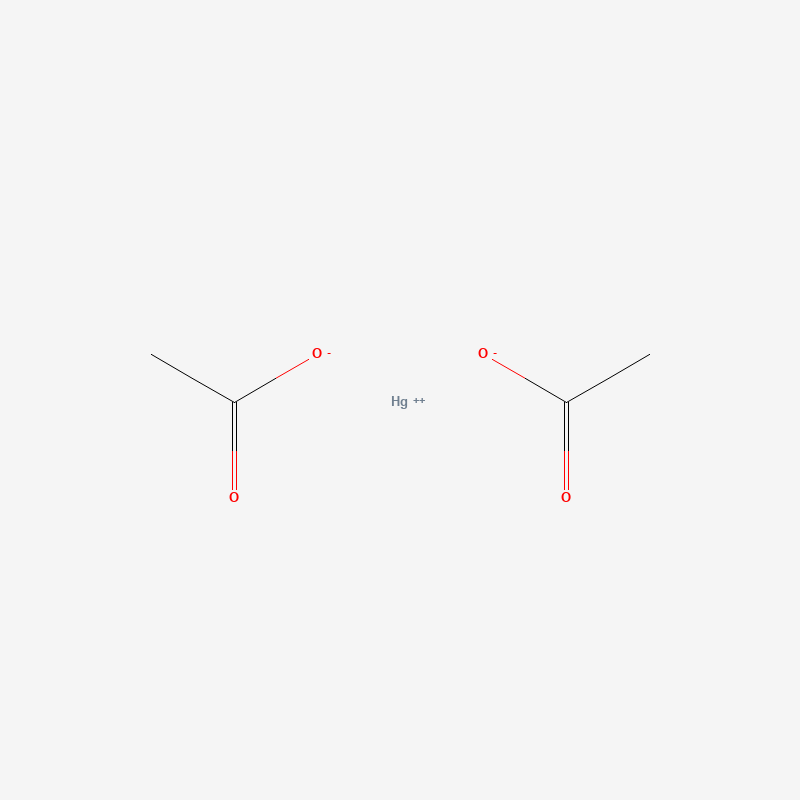
1.25×
mercury(II) acetate Formula
- CAS Number
- 1600-27-7
- Molecular formula
- C4H6HgO4
- Molecular weight
- 318.68
- Exact mass
- 319.997252
- IUPAC name
- mercury(2+) diacetate
- SMILES
CC(=O)[O-].CC(=O)[O-].[Hg+2]- InChI
InChI=1S/2C2H4O2.Hg/c2*1-2(3)4;/h2*1H3,(H,3,4);/q;;+2/p-2- InChIKey
BRMYZIKAHFEUFJ-UHFFFAOYSA-L
Data source: Pubchem
view
mercury(II) acetate Synonyms (63 total)
1600-27-7
216-491-1
592-63-2
acetate mercurique
acetato de mercurio
acetato di mercurio
Acetic acid, mercuridi-
Acetic acid, mercury(2+) salt
Acetic acid, mercury salt
(acetyloxy)mercurio acetate
AI3-04458
AKOS015950690
Bis(acetyloxy)mercury
C4H6HgO4
CAS-1600-27-7
Caswell No. 543A
CCRIS 7488
CHEBI:33211
Diacetoxymercury
DTXCID2022123
Acetic acid, mercury(2+) salt (2:1)
DTXSID4042123
EBC-312055
EINECS 209-766-2
EINECS 216-491-1
EPA Pesticide Chemical Code 052104
FM44547
Hg(OAc)2
HSDB 1244
Mercuriacetate
MERCURIC ACETATE
MERCURIC ACETATE [HSDB]
MERCURIC ACETATE [MI]
mercuric;diacetate
Mercuric diacetate
mercury (2+) acetate
Mercury(2+) acetate
mercury (2+) diacetate
mercury(2+) diacetate
mercury(2+);diacetate
Mercury acetate
Mercury acetate (Hg(CH3CO2)2)
Mercury acetate (Hg(O2C2H3)2)
Mercury acetate [UN1629] [Poison]
Mercury di(acetate)
Mercury diacetate
mercury (II) acetate
mercury (II)-acetate
mercury(II)-acetate
mercury(II)acetate
Mercury(II) acetate
Mercury(II) acetate, A.C.S. reagent
Mercuryl acetate
NCGC00255964-01
NS00082996
NSC 215199
NSC-215199
R0G1MCT8Y5
RefChem:156566
SCHEMBL18951
Tox21_302000
UN1629
UNII-R0G1MCT8Y5
mercury(II) acetate Safety & hazards
Signal wordDanger
Hazard statements
- H300 (100%): Fatal if swallowed [Danger Acute toxicity, oral]
- H310 (100%): Fatal in contact with skin [Danger Acute toxicity, dermal]
- H330 (100%): Fatal if inhaled [Danger Acute toxicity, inhalation]
- H373 (100%): May causes damage to organs through prolonged or repeated exposure [Warning Specific target organ toxicity, repeated exposure]
- H400 (100%): Very toxic to aquatic life [Warning Hazardous to the aquatic environment, acute hazard]
- H410 (100%): Very toxic to aquatic life with long lasting effects [Warning Hazardous to the aquatic environment, long-term hazard]
- H300: Fatal if swallowed [Danger Acute toxicity, oral]
- H311: Toxic in contact with skin [Danger Acute toxicity, dermal]
- H314: Causes severe skin burns and eye damage [Danger Skin corrosion/irritation]
- H317: May cause an allergic skin reaction [Warning Sensitization, Skin]
- H318: Causes serious eye damage [Danger Serious eye damage/eye irritation]
- H341: Suspected of causing genetic defects [Warning Germ cell mutagenicity]
- H361: Suspected of damaging fertility or the unborn child [Warning Reproductive toxicity]
- H371: May cause damage to organs [Warning Specific target organ toxicity, single exposure]
Data sourced from PubChem
