mercury(II) nitrate Chemical Formula
mercury(2+) dinitrate
mercury(II) nitrate CAS No: 10045-94-0 mercury(II) nitrate Molecular formula: HgN2O6 PubChem CID: 24864
Hazard
Danger
mercury(II) nitrate Chemical Manufacturers and suppliers listings
No active product listings for mercury(II) nitrate chemical yet.
mercury(II) nitrate Structure
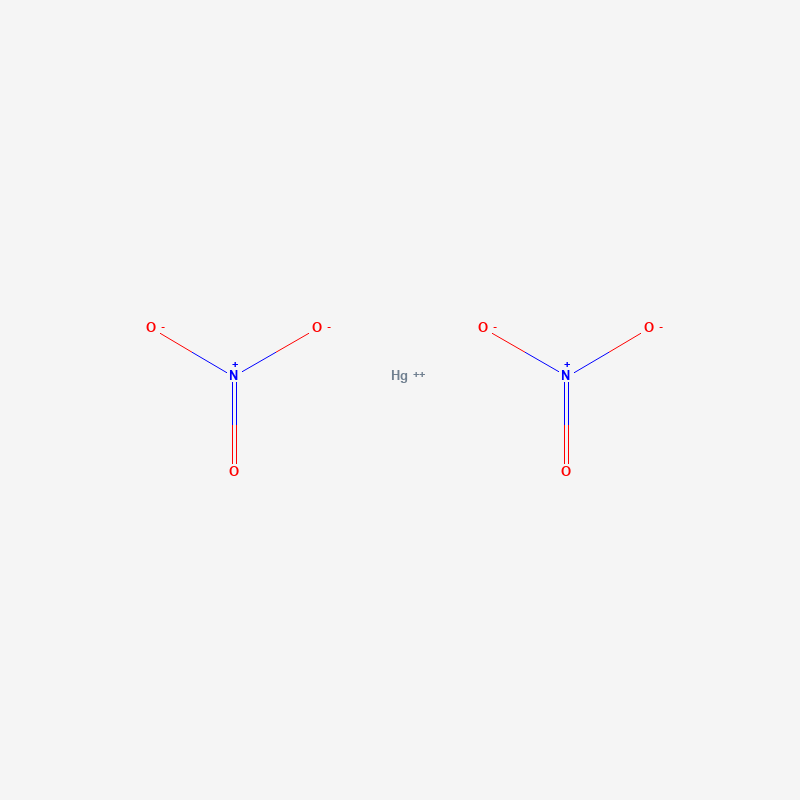
1.25×
mercury(II) nitrate Formula
- CAS Number
- 10045-94-0
- Molecular formula
- HgN2O6
- Molecular weight
- 324.60
- Exact mass
- 325.946279
- IUPAC name
- mercury(2+) dinitrate
- SMILES
[N+](=O)([O-])[O-].[N+](=O)([O-])[O-].[Hg+2]- InChI
InChI=1S/Hg.2NO3/c;2*2-1(3)4/q+2;2*-1- InChIKey
ORMNPSYMZOGSSV-UHFFFAOYSA-N
Data source: Pubchem
view
mercury(II) nitrate Synonyms (37 total)
10045-94-0
233-152-3
2FMV9338BW
Citrine ointment
DB-255119
DTXCID7024162
DTXSID9044162
EINECS 233-152-3
HSDB 1161
mercuric;dinitrate
MERCURIC NITRATE
MERCURIC NITRATE [HSDB]
MERCURIC NITRATE [MI]
MERCURIC NITRATE [WHO-DD]
mercury(2+);dinitrate
Mercury(2+) nitrate
Mercury dinitrate
Mercury(II) nitrate
Mercury(II) nitrate (1:2)
Mercury nitrate monohydrate
Chinese Pharmacopoeia 0.05M Mercuric Nitrate
HgN2O6
Mercuric nitrate [UN1625] [Poison]
Mercury pernitrate
Millon's reagent
Nitrate mercurique
Nitrate mercurique [French]
Nitric acid, mercury(2+) salt
Nitric acid mercury (2+) salt (2:1)
Nitric acid, mercury(2+) salt (2:1)
Nitric acid, mercury(II) salt
NS00093538
ORMNPSYMZOGSSV-UHFFFAOYSA-N
Reagecon Mercuric (II) Nitrate Test Solution according to Chinese Pharmacopoeia (ChP)
RefChem:1088953
SCHEMBL156178
UNII-2FMV9338BW
mercury(II) nitrate Safety & hazards
Signal wordDanger
Hazard statements
- H272 (49.4%): May intensify fire; oxidizer [Danger Oxidizing liquids; Oxidizing solids]
- H300+H310+H330 (49.4%): Fatal if swallowed, in contact with skin or if inhaled [Danger Acute toxicity, oral; acute toxicity, dermal; acute toxicity, inhalation]
- H300 (98.7%): Fatal if swallowed [Danger Acute toxicity, oral]
- H310 (98.7%): Fatal in contact with skin [Danger Acute toxicity, dermal]
- H330 (98.7%): Fatal if inhaled [Danger Acute toxicity, inhalation]
- H373 (100%): May causes damage to organs through prolonged or repeated exposure [Warning Specific target organ toxicity, repeated exposure]
- H400 (98.7%): Very toxic to aquatic life [Warning Hazardous to the aquatic environment, acute hazard]
- H410 (98.7%): Very toxic to aquatic life with long lasting effects [Warning Hazardous to the aquatic environment, long-term hazard]
- H300: Fatal if swallowed [Danger Acute toxicity, oral]
- H310: Fatal in contact with skin [Danger Acute toxicity, dermal]
- H314: Causes severe skin burns and eye damage [Danger Skin corrosion/irritation]
- H317: May cause an allergic skin reaction [Warning Sensitization, Skin]
- H318: Causes serious eye damage [Danger Serious eye damage/eye irritation]
- H341: Suspected of causing genetic defects [Warning Germ cell mutagenicity]
- H361: Suspected of damaging fertility or the unborn child [Warning Reproductive toxicity]
- H370: Causes damage to organs [Danger Specific target organ toxicity, single exposure]
- H371: May cause damage to organs [Warning Specific target organ toxicity, single exposure]
- H372: Causes damage to organs through prolonged or repeated exposure [Danger Specific target organ toxicity, repeated exposure]
Data sourced from PubChem
