molybdenum(VI) oxide Chemical Formula
trioxomolybdenum
molybdenum(VI) oxide CAS No: 1313-27-5 molybdenum(VI) oxide Molecular formula: MoO3 PubChem CID: 14802
Hazard
Warning
molybdenum(VI) oxide Chemical Manufacturers and suppliers listings
No active product listings for molybdenum(VI) oxide chemical yet.
molybdenum(VI) oxide Structure
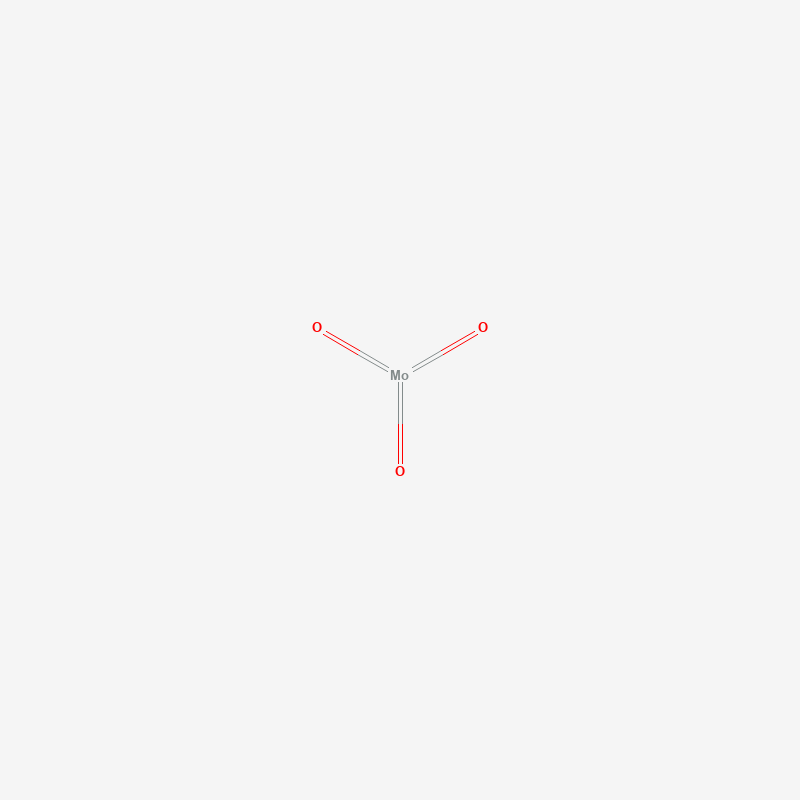
1.25×
Molybdenum Trioxide can cause cancer according to California Labor Code and the World Health Organization's International Agency for Research on Cancer (IARC).
molybdenum(VI) oxide Formula
- CAS Number
- 1313-27-5
- Molecular formula
- MoO3
- Molecular weight
- 143.95
- Exact mass
- 145.890147
- IUPAC name
- trioxomolybdenum
- SMILES
O=[Mo](=O)=O- InChI
InChI=1S/Mo.3O- InChIKey
JKQOBWVOAYFWKG-UHFFFAOYSA-N
Data source: Pubchem
view
molybdenum(VI) oxide Industries & Uses
Metal Preparation and Pouring
Petroleum Production and Refining
Painting (Pigments, Binders, and Biocides)
Ceramics making
Enameling
molybdenum(VI) oxide Synonyms (63 total)
1313-27-5
215-204-7
22FQ3F03YS
AKOS015904164
CAS-1313-27-5
CCRIS 1163
CHEBI:30627
DTXCID30899
DTXSID7020899
EC 215-204-7
EINECS 215-204-7
EINECS 234-321-4
HSDB 1661
Mo 1202T
Mo-1202T
Molybdena
molybdenum(6+) oxide
Molybdenum anhydride
Molybdenum oxide (MoO3)
Molybdenum oxide (MoO5)
Molybdenum oxide nanopowder (<100 nm)
Molybdenum Oxide Powder
Molybdenum Oxide Powder, 99.5% Nano
Molybdenum peroxide
Molybdenumperoxide
MOLYBDENUM TRIOXIDE
MOLYBDENUM TRIOXIDE [HSDB]
MOLYBDENUM TRIOXIDE [IARC]
MOLYBDENUM TRIOXIDE [MI]
Molybdenum trioxide, Molybdena, Natural molybdite, Dioxomolybdenum, Molybdic oxide, Molybdenum(VI) oxide, Trioxomolybdenum, Molybdenum anhydride, Molybdic anhydride, Molybdic anhydride, Natural molybdite, Diketomolybdenum, Molybdic acid anhydride
MOLYBDENUM TRIOXIDE [WHO-DD]
molybdenum(VI)oxide
Molybdenum (VI) oxide
Molybdenum(VI) oxide
Molybdenum(VI) oxide, 99.97% trace metals basis
Molybdenum(VI) oxide ACS reagent
Molybdenum(VI) oxide, ACS reagent, >=99.5%
Molybdenum(VI) oxide, nanopowder, 100 nm (TEM), 99.5% trace metals basis
Molybdenum(VI) oxide, p.a., 99.0%
Molybdenum(VI) oxide, p.a., ACS reagent, 99.5%
Molybdenum(VI) oxide, puriss. p.a., 99.5%
Molybdenum(VI) oxide, ReagentPlus(R), >=99.5%
Molybdenum(VI) oxide, Vetec(TM) reagent grade
Molybdic acid anhydride
Molybdic anhydride
Molybdic oxide
Molybdic trioxide
[MoO3]
MoO3
Natural molybdite
NCGC00260331-01
NS00081390
NSC 215191
NSC-215191
NSC215191
Q416416
RefChem:159392
SCHEMBL21493
Tox21_202785
trioxomolybdenum
Tris(oxido)molybdenum
UNII-22FQ3F03YS
WLN: MO O3
molybdenum(VI) oxide Safety & hazards
Signal wordWarning
Hazard statements
- H319: Causes serious eye irritation [Warning Serious eye damage/eye irritation]
- H335: May cause respiratory irritation [Warning Specific target organ toxicity, single exposure; Respiratory tract irritation]
- H351: Suspected of causing cancer [Warning Carcinogenicity]
- H319 (> 99.9%): Causes serious eye irritation [Warning Serious eye damage/eye irritation]
- H335 (> 99.9%): May cause respiratory irritation [Warning Specific target organ toxicity, single exposure; Respiratory tract irritation]
- H351 (99.8%): Suspected of causing cancer [Warning Carcinogenicity]
- H361: Suspected of damaging fertility or the unborn child [Warning Reproductive toxicity]
- H372: Causes damage to organs through prolonged or repeated exposure [Danger Specific target organ toxicity, repeated exposure]
- H373: May causes damage to organs through prolonged or repeated exposure [Warning Specific target organ toxicity, repeated exposure]
- H301: Toxic if swallowed [Danger Acute toxicity, oral]
- H370: Causes damage to organs [Danger Specific target organ toxicity, single exposure]
Data sourced from PubChem