phosphorus pentasulfide Chemical Formula
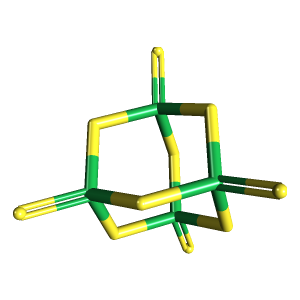
1,3,5,7-tetrakis(sulfanylidene)-2,4,6,8,9,10-hexathia-1lambda5,3lambda5,5lambda5,7lambda5-tetraphosphatricyclo[3.3.1.13,7]decane
phosphorus pentasulfide CAS No: 1314-80-3 phosphorus pentasulfide Molecular formula: P4S10 PubChem CID: 14817
Hazard
Danger
phosphorus pentasulfide Chemical Manufacturers and suppliers listings
No active product listings for phosphorus pentasulfide chemical yet.
phosphorus pentasulfide Structure
1.25×
3D conformer
phosphorus pentasulfide Formula
- CAS Number
- 1314-80-3
- Molecular formula
- P4S10
- Molecular weight
- 444.6
- Exact mass
- 443.6157597
- IUPAC name
- 1,3,5,7-tetrakis(sulfanylidene)-2,4,6,8,9,10-hexathia-1lambda5,3lambda5,5lambda5,7lambda5-tetraphosphatricyclo[3.3.1.13,7]decane
- SMILES
P12(=S)SP3(=S)SP(=S)(S1)SP(=S)(S2)S3- InChI
InChI=1S/P4S10/c5-1-9-2(6)12-3(7,10-1)14-4(8,11-1)13-2- InChIKey
CYQAYERJWZKYML-UHFFFAOYSA-N
Data source: Pubchem
view
phosphorus pentasulfide Industries & Uses
Toxic Gas from Spilling Chemical in Water
phosphorus pentasulfide Synonyms (42 total)
AKOS015961860
Diphosphorus pentasulfide
Diphosphorus pentasulphide
DTXCID8030213
DTXSID0051659
EC 215-242-4
EINECS 215-242-4
Pentasulfure de phosphore
Pentasulfure de phosphore [French]
Phosphoric sulfide
phosphorous pentasulfide
Phosphorus pentasulfide
PHOSPHORUS PENTASULFIDE [HSDB]
PHOSPHORUS PENTASULFIDE [MI]
Phosphorus pentasulfide (P4S10)
Phosphorus pentasulphide
Phosphorus persulfide
Phosphorus sulfide
Phosphorus sulfide (P2S5)
Phosphorus(V) sulfide
1314-80-3
1,3,5,7-tetrathioxo-2,4,6,8,9,10-hexathia-1lambda5,3lambda5,5lambda5,7lambda5-tetraphosphatricyclo[3.3.1.13,7]decane
1lambda~5~,3lambda~5~,5lambda~5~,7lambda~5~-Tricyclo[3.3.1.1~3,7~]tetraphosphathiane-1,3,5,7-tetrathione
215-242-4
HJ1X20J1DX
HSDB 1251
P4S10
Phosphorus pentasulfide, free from yellow or white phosphorus
Phosphorus pentasulfide, free from yellow or white phosphorus [UN1340] [Dangerous when wet]
PQA7DX2B3M
Q415704
RCRA waste no. U189
RCRA waste number U189
RefChem:173921
SCHEMBL6316377
Sirnik fosforecny
Sirnik fosforecny [Czech]
Sulfur phosphide
Tetraphosphorus decasulfide
Thiophosphoric anhydride
UN1340
UNII-HJ1X20J1DX
phosphorus pentasulfide Safety & hazards
Signal wordDanger
Hazard statements
- H228: Flammable solid [Danger Flammable solids]
- H260: In contact with water releases flammable gases which may ignite spontaneously [Danger Substances and mixtures which in contact with water, emit flammable gases]
- H302: Harmful if swallowed [Warning Acute toxicity, oral]
- H332: Harmful if inhaled [Warning Acute toxicity, inhalation]
- H400: Very toxic to aquatic life [Warning Hazardous to the aquatic environment, acute hazard]
- H228 (100%): Flammable solid [Danger Flammable solids]
- H260 (100%): In contact with water releases flammable gases which may ignite spontaneously [Danger Substances and mixtures which in contact with water, emit flammable gases]
- H301+H331 (65.2%): Toxic if swallowed or if inhaled [Danger Acute toxicity, oral; acute toxicity, inhalation]
- H301 (65.2%): Toxic if swallowed [Danger Acute toxicity, oral]
- H302+H332 (19.7%): Harmful if swallowed or if inhaled [Warning Acute toxicity, oral; acute toxicity, inhalation]
- H302 (34.8%): Harmful if swallowed [Warning Acute toxicity, oral]
- H311 (65.2%): Toxic in contact with skin [Danger Acute toxicity, dermal]
- H314 (66.1%): Causes severe skin burns and eye damage [Danger Skin corrosion/irritation]
- H318 (66.1%): Causes serious eye damage [Danger Serious eye damage/eye irritation]
- H319 (19.7%): Causes serious eye irritation [Warning Serious eye damage/eye irritation]
- H332 (100%): Harmful if inhaled [Warning Acute toxicity, inhalation]
- H400 (100%): Very toxic to aquatic life [Warning Hazardous to the aquatic environment, acute hazard]
- H261: In contact with water releases flammable gas [Danger Substances and mixtures which in contact with water, emit flammable gases]
- H315: Causes skin irritation [Warning Skin corrosion/irritation]
- H319: Causes serious eye irritation [Warning Serious eye damage/eye irritation]
- H335: May cause respiratory irritation [Warning Specific target organ toxicity, single exposure; Respiratory tract irritation]
- H313: May be harmful in contact with skin [Warning Acute toxicity, dermal]
- H318: Causes serious eye damage [Danger Serious eye damage/eye irritation]
- H371: May cause damage to organs [Warning Specific target organ toxicity, single exposure]
Data sourced from PubChem