potassium bromate Chemical Formula
potassium bromate
potassium bromate CAS No: 7758-01-2 potassium bromate Molecular formula: BrKO3 PubChem CID: 23673461
Hazard
Danger
potassium bromate Chemical Manufacturers and suppliers listings
No active product listings for potassium bromate chemical yet.
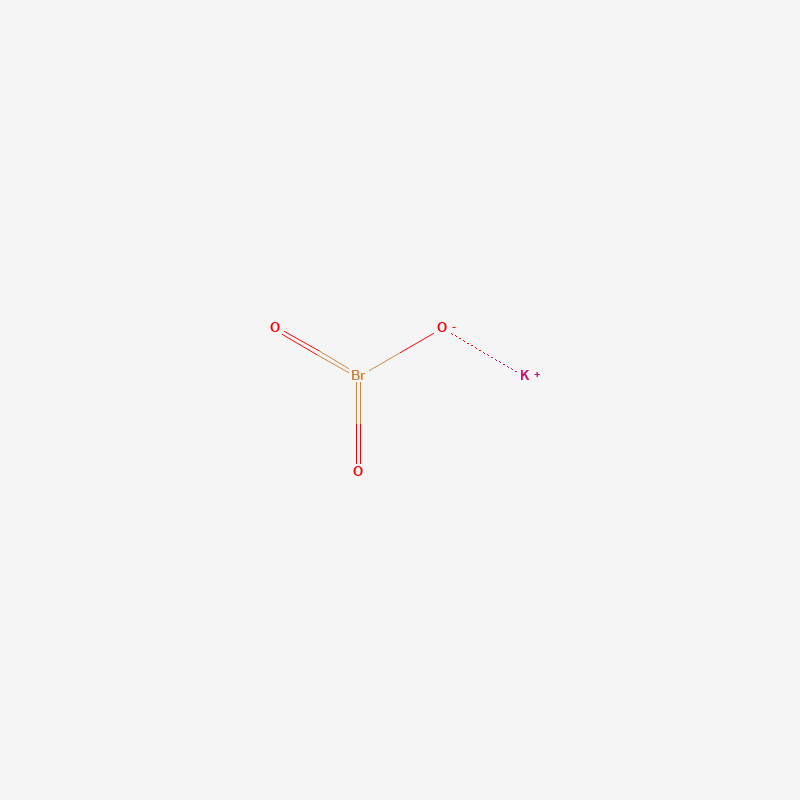
potassium bromate Structure
1.25×
Potassium bromate can cause cancer according to The World Health Organization's International Agency for Research on Cancer (IARC).
potassium bromate Formula
- CAS Number
- 7758-01-2
- Molecular formula
- BrKO3
- Molecular weight
- 167.00
- Exact mass
- 165.86679
- IUPAC name
- potassium bromate
- SMILES
[O-]Br(=O)=O.[K+]- InChI
InChI=1S/BrHO3.K/c2-1(3)4;/h(H,2,3,4);/q;+1/p-1- InChIKey
OCATYIAKPYKMPG-UHFFFAOYSA-M
Data source: Pubchem
view
potassium bromate Industries & Uses
Dressing Hair
potassium bromate Synonyms (51 total)
0.033M Potassium bromate
04MB35W6ZA
231-829-8
7758-01-2
AKOS015904451
BP-30178
BR1192
BrKO3
Bromate, potassium
Bromic acid, potassium salt
C19295
CCRIS 529
CHEBI:38211
CHEMBL2311074
DTXCID40195
DTXSID6020195
EC 231-829-8
EEC No. E924
EINECS 231-829-8
HSDB 1253
0.033M Potassium Bromate according to European Pharmacopoeia 4.2.2.
Bromic acid, potassium salt (1:1)
BROMIC ACID POTASSIUM SALT (1:1)
E924
Kaliumbromat
MFCD00011359
NS00076351
NSC 215200
NSC-215200
potassium;bromate
POTASSIUM BROMATE
Potassium bromate ACS reagent
potassium bromate-bromide
Potassium bromate(DOT)
POTASSIUM BROMATE [FCC]
POTASSIUM BROMATE [HSDB]
POTASSIUM BROMATE [IARC]
POTASSIUM BROMATE [MART.]
POTASSIUM BROMATE [MI]
potassium bromate/potassium bromide
Potassium bromate [UN1484] [Oxidizer]
Potassium bromate(V) (KBrO3)
POTASSIUM BROMATE [WHO-DD]
potassium trioxidobromate(1-)
potassium trioxobromate
Q409241
Reagecon Potassium Bromate 0.01667M according to Chinese Pharmacopoeia (ChP)
Reagecon Potassium Bromate 0.1N according to United States Pharmacopoeia (USP)
RefChem:175433
UN1484
UNII-04MB35W6ZA
potassium bromate Safety & hazards
Signal wordDanger
Hazard statements
- H271: May cause fire or explosion; strong Oxidizer [Danger Oxidizing liquids; Oxidizing solids]
- H301: Toxic if swallowed [Danger Acute toxicity, oral]
- H350: May cause cancer [Danger Carcinogenicity]
- H271 (99.5%): May cause fire or explosion; strong Oxidizer [Danger Oxidizing liquids; Oxidizing solids]
- H301 (100%): Toxic if swallowed [Danger Acute toxicity, oral]
- H350 (97.9%): May cause cancer [Danger Carcinogenicity]
- H272: May intensify fire; oxidizer [Danger Oxidizing liquids; Oxidizing solids]
- H341: Suspected of causing genetic defects [Warning Germ cell mutagenicity]
- H370: Causes damage to organs [Danger Specific target organ toxicity, single exposure]
- H372: Causes damage to organs through prolonged or repeated exposure [Danger Specific target organ toxicity, repeated exposure]
- H302: Harmful if swallowed [Warning Acute toxicity, oral]
- H320: Causes eye irritation [Warning Serious eye damage/eye irritation]
- H335: May cause respiratory irritation [Warning Specific target organ toxicity, single exposure; Respiratory tract irritation]
- H351: Suspected of causing cancer [Warning Carcinogenicity]
- H316: Causes mild skin irritation [Warning Skin corrosion/irritation]
- H319: Causes serious eye irritation [Warning Serious eye damage/eye irritation]
Data sourced from PubChem
