rhodium(III) nitrate Chemical Formula
rhodium(3+);trinitrate;dihydrate
rhodium(III) nitrate CAS No: 13465-43-5 rhodium(III) nitrate Molecular formula: H4N3O11Rh PubChem CID: 23165641
Hazard
Danger
rhodium(III) nitrate Chemical Manufacturers and suppliers listings
No active product listings for rhodium(III) nitrate chemical yet.
rhodium(III) nitrate Structure
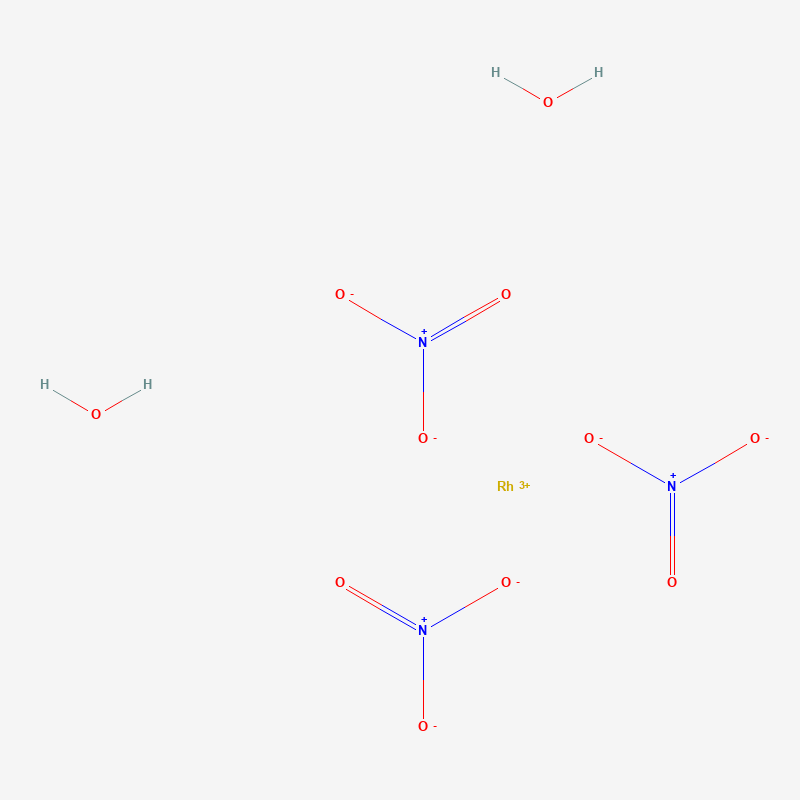
1.25×
rhodium(III) nitrate Formula
- CAS Number
- 13465-43-5
- Molecular formula
- H4N3O11Rh
- Molecular weight
- 324.95
- Exact mass
- 324.89008
- IUPAC name
- rhodium(3+);trinitrate;dihydrate
- SMILES
[N+](=O)([O-])[O-].[N+](=O)([O-])[O-].[N+](=O)([O-])[O-].O.O.[Rh+3]- InChI
InChI=1S/3NO3.2H2O.Rh/c3*2-1(3)4;;;/h;;;2*1H2;/q3*-1;;;+3- InChIKey
SULCFFJNLVZXGH-UHFFFAOYSA-N
Data source: Pubchem
view
rhodium(III) nitrate Synonyms (14 total)
13465-43-5
603-842-2
AKOS015914488
DTXSID70631163
H4N3O11Rh
MFCD00149836
RefChem:883031
rhodium(3+);trinitrate;dihydrate
Rhodium(III) nitrate dihydrate
Rhodium(III)-nitrate hydrate
SCHEMBL3419499
SULCFFJNLVZXGH-UHFFFAOYSA-N
Nitric acid,rhodium(3+) salt, dihydrate (8CI,9CI)
Rhodium(3+) nitrate--water (1/3/2)
rhodium(III) nitrate Safety & hazards
Signal wordDanger
Hazard statements
- H271 (99.2%): May cause fire or explosion; strong Oxidizer [Danger Oxidizing liquids; Oxidizing solids]
- H290 (100%): May be corrosive to metals [Warning Corrosive to Metals]
- H302 (100%): Harmful if swallowed [Warning Acute toxicity, oral]
- H314 (100%): Causes severe skin burns and eye damage [Danger Skin corrosion/irritation]
- H317 (100%): May cause an allergic skin reaction [Warning Sensitization, Skin]
- H318 (100%): Causes serious eye damage [Danger Serious eye damage/eye irritation]
- H341 (99.2%): Suspected of causing genetic defects [Warning Germ cell mutagenicity]
- H400 (100%): Very toxic to aquatic life [Warning Hazardous to the aquatic environment, acute hazard]
- H410 (100%): Very toxic to aquatic life with long lasting effects [Warning Hazardous to the aquatic environment, long-term hazard]
Data sourced from PubChem
