rhodium(III) sulfate Chemical Formula
bis(rhodium(3+));trisulfate
rhodium(III) sulfate CAS No: 10489-46-0 rhodium(III) sulfate Molecular formula: O12Rh2S3 PubChem CID: 159290
Hazard
Danger
rhodium(III) sulfate Chemical Manufacturers and suppliers listings
No active product listings for rhodium(III) sulfate chemical yet.
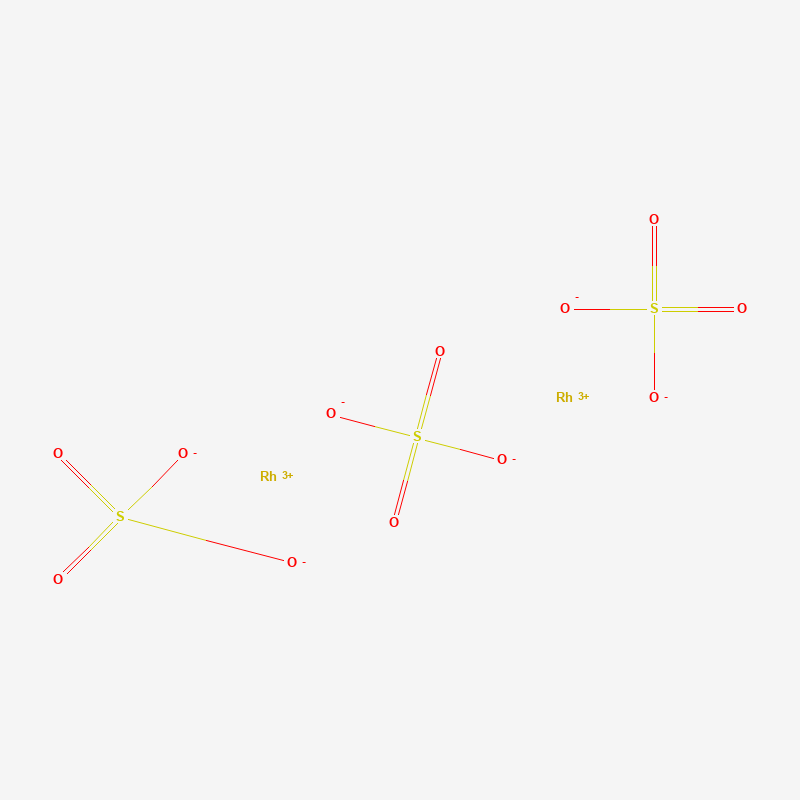
rhodium(III) sulfate Structure
1.25×
rhodium(III) sulfate Formula
- CAS Number
- 10489-46-0
- Molecular formula
- O12Rh2S3
- Molecular weight
- 494.0
- Exact mass
- 493.66618
- IUPAC name
- bis(rhodium(3+));trisulfate
- SMILES
[O-]S(=O)(=O)[O-].[O-]S(=O)(=O)[O-].[O-]S(=O)(=O)[O-].[Rh+3].[Rh+3]- InChI
InChI=1S/3H2O4S.2Rh/c3*1-5(2,3)4;;/h3*(H2,1,2,3,4);;/q;;;2*+3/p-6- InChIKey
YWFDDXXMOPZFFM-UHFFFAOYSA-H
Data source: Pubchem
view
rhodium(III) sulfate Synonyms (20 total)
10489-46-0
DB-231737
Dirhodium trisulphate
DTXCID001030967
DTXSID20890662
EINECS 234-014-5
MFCD00016309
O12Rh2S3
RefChem:186697
Rhodium(3+) sulfate (2/3)
rhodium(3+);trisulfate
Rhodium(III) sulfate
Rhodium(III) sulfate ~8% in H2O
RHODIUM SULFATE
SCHEMBL138365
AT40014
FR37917
Rhodium(III) sulfate aqueous solution, 5% Rhodium content
RHODIUM(III) SULFATE SOLUTION (5% IN WATER)
Sulfuric acid, rhodium(3+) salt (3:2)
rhodium(III) sulfate Safety & hazards
Signal wordDanger
Hazard statements
- H290 (46.4%): May be corrosive to metals [Warning Corrosive to Metals]
- H314 (51.2%): Causes severe skin burns and eye damage [Danger Skin corrosion/irritation]
- H315 (48.8%): Causes skin irritation [Warning Skin corrosion/irritation]
- H318 (46.4%): Causes serious eye damage [Danger Serious eye damage/eye irritation]
- H319 (48.8%): Causes serious eye irritation [Warning Serious eye damage/eye irritation]
- H335 (48.8%): May cause respiratory irritation [Warning Specific target organ toxicity, single exposure; Respiratory tract irritation]
- H341 (31%): Suspected of causing genetic defects [Warning Germ cell mutagenicity]
- H400 (29.8%): Very toxic to aquatic life [Warning Hazardous to the aquatic environment, acute hazard]
- H410 (29.8%): Very toxic to aquatic life with long lasting effects [Warning Hazardous to the aquatic environment, long-term hazard]
Data sourced from PubChem
