sodium cyanide Chemical Formula
sodium cyanide
sodium cyanide CAS No: 143-33-9 sodium cyanide Molecular formula: CNNa PubChem CID: 8929
Hazard
Danger
sodium cyanide Chemical Manufacturers and suppliers listings
No active product listings for sodium cyanide chemical yet.
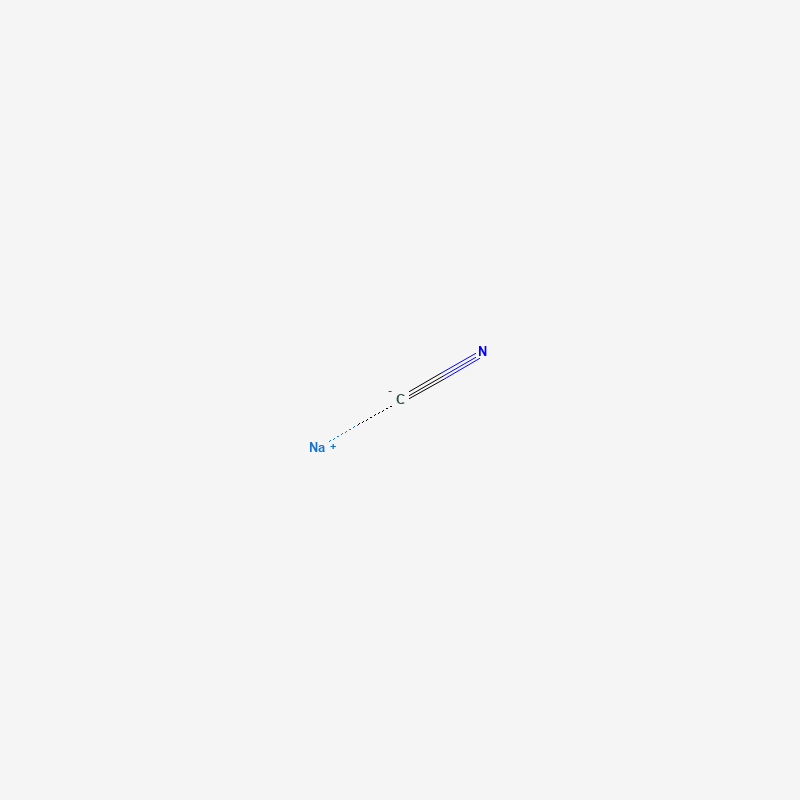
sodium cyanide Structure
1.25×
Sodium cyanide is a cyanide salt containing equal numbers of sodium cations and cyanide anions. It has a role as an EC 1.15.1.1 (superoxide dismutase) inhibitor. It is a sodium salt, a cyanide salt and a one-carbon compound.
sodium cyanide Formula
- CAS Number
- 143-33-9
- Molecular formula
- CNNa
- Molecular weight
- 49.007
- Exact mass
- 48.99284329
- IUPAC name
- sodium cyanide
- SMILES
[C-]#N.[Na+]- InChI
InChI=1S/CN.Na/c1-2;/q-1;+1- InChIKey
MNWBNISUBARLIT-UHFFFAOYSA-N
Data source: Pubchem
view
sodium cyanide Industries & Uses
Steel Producing
Electroplating
Toxic Gas from Spilling Chemical in Water
sodium cyanide Synonyms (69 total)
143-33-9
205-599-4
AKOS009159016
BRN 3587243
C18673
Caswell No. 758
CHEBI:33192
CHEMBL1644697
Cianuro di sodio
Cianuro di sodio [Italian]
CNNa
Cyanasalt H
Cyanasalt S
Cyanide of sodium
Cyanide, Sodium
Cyanobrik
Cyanogran
cyano sodium
cyanosodium
Cyanure de sodium
Cyanure de sodium [French]
Cyanure de sodium [ISO-French]
Cymag
DTXCID604309
DTXSID4024309
EC 205-599-4
EINECS 205-599-4
EPA Pesticide Chemical Code 074002
HSDB 734
Hydrocyanic acid, sodium salt
Kyanid sodny
Kyanid sodny [Czech]
M-44 cyanide capsules
MFCD00003523
NaCN
Natriumcyanid
Natriumzyanid
NS00075633
NSC 77379
NSC-77379
NSC77379
O5DDB9Z95G
Q410185
RCRA waste no. P106
RCRA waste number P106
RefChem:6235
RTVFYQXEHKQMKO-UHFFFAOYSA-N
SCHEMBL387
SCHEMBL388
sodiumcarbonitrile
sodium cyanide-
sodium-cyanide
sodium;cyanide
SODIUM CYANIDE
Sodium Cyanide ACS grade
Sodium cyanide, ACS reagent, >=95.0%
Sodium cyanide, granular
SODIUM CYANIDE [HSDB]
Sodium cyanide [ISO]
Sodium cyanide, JIS special grade, >=97.0%
Sodium cyanide (Na(CN))
Sodium cyanide, reagent grade, 97%
Sodium cyanide, SAJ first grade, >=90.0%
Sodium cyanide, solid
Sodium cyanide [UN1689] [Poison]
UN1689
UNII-O5DDB9Z95G
WLN: NA CN
WLN: NC-NA-
sodium cyanide Safety & hazards
Signal wordDanger
Hazard statements
- H290 (45.3%): May be corrosive to metals [Warning Corrosive to Metals]
- H300+H310+H330 (36%): Fatal if swallowed, in contact with skin or if inhaled [Danger Acute toxicity, oral; acute toxicity, dermal; acute toxicity, inhalation]
- H300 (100%): Fatal if swallowed [Danger Acute toxicity, oral]
- H310 (100%): Fatal in contact with skin [Danger Acute toxicity, dermal]
- H315 (12.2%): Causes skin irritation [Warning Skin corrosion/irritation]
- H318 (30.5%): Causes serious eye damage [Danger Serious eye damage/eye irritation]
- H319 (14.3%): Causes serious eye irritation [Warning Serious eye damage/eye irritation]
- H330 (100%): Fatal if inhaled [Danger Acute toxicity, inhalation]
- H372 (44.8%): Causes damage to organs through prolonged or repeated exposure [Danger Specific target organ toxicity, repeated exposure]
- H400 (98.8%): Very toxic to aquatic life [Warning Hazardous to the aquatic environment, acute hazard]
- H410 (98.8%): Very toxic to aquatic life with long lasting effects [Warning Hazardous to the aquatic environment, long-term hazard]
- H300: Fatal if swallowed [Danger Acute toxicity, oral]
- H310: Fatal in contact with skin [Danger Acute toxicity, dermal]
- H316: Causes mild skin irritation [Warning Skin corrosion/irritation]
- H319: Causes serious eye irritation [Warning Serious eye damage/eye irritation]
- H361: Suspected of damaging fertility or the unborn child [Warning Reproductive toxicity]
- H372: Causes damage to organs through prolonged or repeated exposure [Danger Specific target organ toxicity, repeated exposure]
- H315: Causes skin irritation [Warning Skin corrosion/irritation]
- H330: Fatal if inhaled [Danger Acute toxicity, inhalation]
Data sourced from PubChem