sodium molybdate Chemical Formula
disodium;dioxido(dioxo)molybdenum
sodium molybdate CAS No: 7631-95-0 sodium molybdate Molecular formula: MoNa2O4 PubChem CID: 61424
Hazard
Warning
sodium molybdate Chemical Manufacturers and suppliers listings
No active product listings for sodium molybdate chemical yet.
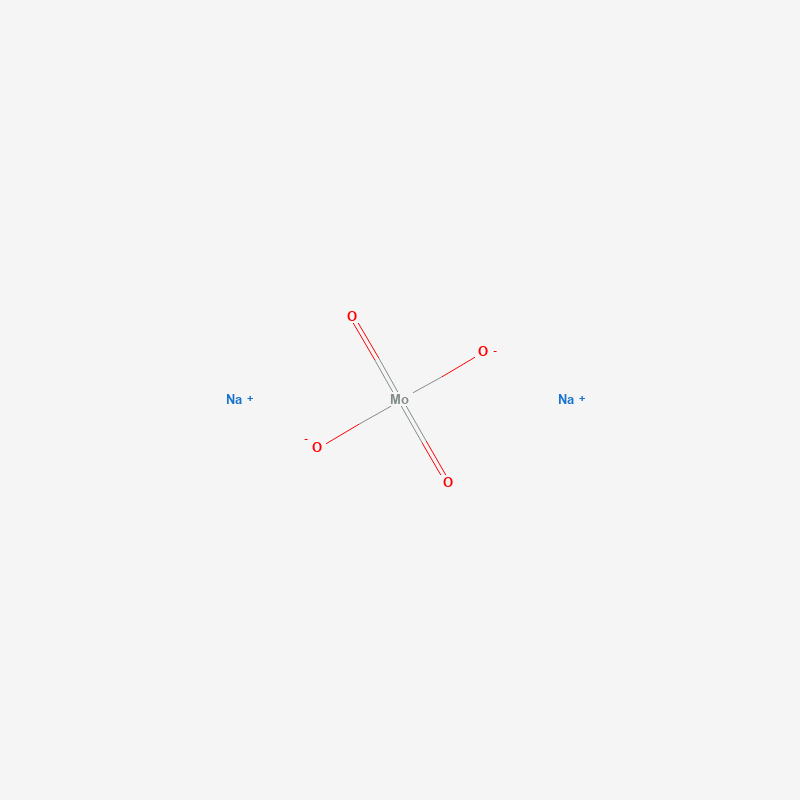
sodium molybdate Structure
1.25×
Sodium molybdate (anhydrous) is an inorganic sodium salt having molybdate as the counterion. It has a role as a NMR chemical shift reference compound and a poison. It contains a molybdate.
sodium molybdate Formula
- CAS Number
- 7631-95-0
- Molecular formula
- MoNa2O4
- Molecular weight
- 205.93
- Exact mass
- 207.864601
- IUPAC name
- disodium;dioxido(dioxo)molybdenum
- SMILES
[O-][Mo](=O)(=O)[O-].[Na+].[Na+]- InChI
InChI=1S/Mo.2Na.4O/q;2*+1;;;2*-1- InChIKey
TVXXNOYZHKPKGW-UHFFFAOYSA-N
Data source: Pubchem
view
sodium molybdate Industries & Uses
Electroplating
sodium molybdate Synonyms (64 total)
13466-16-5
231-551-7
7631-95-0
948QAQ08I1
A11800
AKOS015912969
Anhydric sodium molybdate
CCRIS 5442
CHEBI:75215
DA-77927
DB14496
Disodium molybdate
disodium tetraoxomolybdate
EC 231-551-7
EINECS 231-551-7
FS16161
MFCD00003486
Molybdate disodium
Molybdenum (as sodium)
Molybdic acid, disodium salt
disodium;dioxido(dioxo)molybdenum
Molybdate (MoO42-), disodium, (beta-4)-
Molybdate (MoO42-), disodium, (T-4)-
Molybdate (MoO42-), sodium (1:2), (T-4)-
MOLYBDENUM (AS SODIUM) [VANDF]
Molybdic acid (H2MoO4) , disodium salt
Molybdic acid (H2MoO4), disodium salt
Molybdic acid (H2MoO4), disodium salt (8CI)
Na2MoO4
Natriummolybdat
Natriummolybdat [German]
NS00113264
NSC 77389
NSC-77389
orb1221076
orb3177682
Q414518
RefChem:887699
SCHEMBL20496
Sodium dimolybdate
sodium dioxido(dioxo)molybdenum
Sodium molybdate
Sodiummolybdate
Sodium molybdate, >=98%
sodium molybdate (anh.)
sodium molybdate (anhydrous)
Sodium molybdate - anhydrous
Sodium Molybdate, anhydrous
Sodium Molybdate Anhydrous
Sodium molybdate, anhydrous, powder, -100 mesh particle size, 99.9% trace metals basis
Sodium molybdate, LR, >=99.5%
SODIUM MOLYBDATE [MART.]
Sodium molybdate (Na2MoO4)
Sodium molybdate (VAN)
SODIUM MOLYBDATE [VANDF]
Sodium molybdate(VI)
SODIUM MOLYBDATE(VI) [MI]
SODIUM MOLYBDATE [WHO-DD]
sodium molybdenum oxide
Sodium molybdenum oxide, anhydrous
Sodium molybdenum oxide, anhydrous, Mo 46.2%
SY059341
T5205
UNII-948QAQ08I1
sodium molybdate Safety & hazards
Signal wordWarning
Hazard statements
- H315 (33.1%): Causes skin irritation [Warning Skin corrosion/irritation]
- H319 (33.2%): Causes serious eye irritation [Warning Serious eye damage/eye irritation]
- H332 (33.2%): Harmful if inhaled [Warning Acute toxicity, inhalation]
- H335 (33.1%): May cause respiratory irritation [Warning Specific target organ toxicity, single exposure; Respiratory tract irritation]
- H301: Toxic if swallowed [Danger Acute toxicity, oral]
- H315: Causes skin irritation [Warning Skin corrosion/irritation]
- H319: Causes serious eye irritation [Warning Serious eye damage/eye irritation]
- H335: May cause respiratory irritation [Warning Specific target organ toxicity, single exposure; Respiratory tract irritation]
- H341: Suspected of causing genetic defects [Warning Germ cell mutagenicity]
- H351: Suspected of causing cancer [Warning Carcinogenicity]
- H361: Suspected of damaging fertility or the unborn child [Warning Reproductive toxicity]
- H372: Causes damage to organs through prolonged or repeated exposure [Danger Specific target organ toxicity, repeated exposure]
- H373: May causes damage to organs through prolonged or repeated exposure [Warning Specific target organ toxicity, repeated exposure]
Data sourced from PubChem
