sodium selenate Chemical Formula
disodium;selenate
sodium selenate CAS No: 13410-01-0 sodium selenate Molecular formula: Na2O4Se PubChem CID: 25960
Hazard
Danger
sodium selenate Chemical Manufacturers and suppliers listings
No active product listings for sodium selenate chemical yet.
sodium selenate Structure
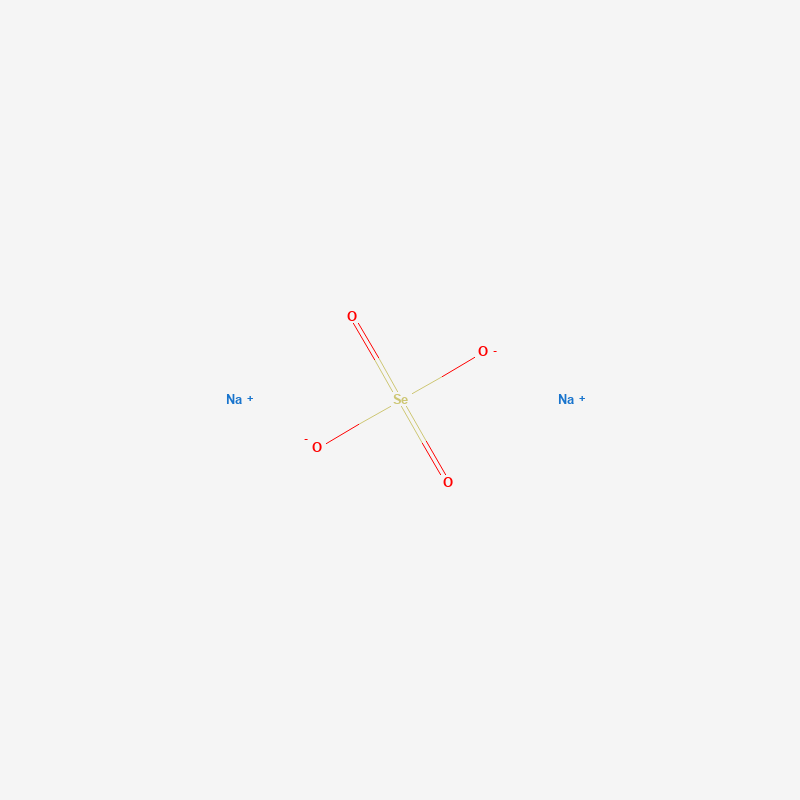
1.25×
Sodium selenate is an inorganic sodium salt having selenate as the counterion. It has a role as a fertilizer, an EC 3.1.3.48 (protein-tyrosine-phosphatase) inhibitor and an anticonvulsant. It contains a selenate.
sodium selenate Formula
- CAS Number
- 13410-01-0
- Molecular formula
- Na2O4Se
- Molecular weight
- 188.95
- Exact mass
- 189.87572
- IUPAC name
- disodium;selenate
- SMILES
[O-][Se](=O)(=O)[O-].[Na+].[Na+]- InChI
InChI=1S/2Na.H2O4Se/c;;1-5(2,3)4/h;;(H2,1,2,3,4)/q2*+1;/p-2- InChIKey
MHQOTKLEMKRJIR-UHFFFAOYSA-L
Data source: Pubchem
view
sodium selenate Industries & Uses
Farming (Pesticides)
sodium selenate Synonyms (46 total)
13410-01-0
236-501-8
5DQP25600A
AI3-10625
AKOS015914024
Caswell No. 791
CCRIS 1259
CHEBI:77775
disodium;selenate
Disodium selenate
DTXCID3012076
DTXSID5032076
EINECS 236-501-8
HSDB 6370
MFCD00003490
MHQOTKLEMKRJIR-UHFFFAOYSA-L
Na2O4Se
Na2SeO4
Natriumseleniat
Natriumseleniat [German]
EPA Pesticide Chemical Code 072002
NS00087188
NSC 378348
NSC-378348
Q419488
RefChem:184094
SCHEMBL81555
Selenate de sodium
Selenate, Disodium
Selenate, Sodium
selenato de sodio
selenato di sodio
Selenic acid, disodium salt
Selenic acid (H2SeO4), disodium salt
Selenic acid, sodium salt (1:2)
SELENIUM (AS SODIUM SELENATE) [VANDF]
Sel-tox SSO2 and SS-20
SODIUM SELENATE
Sodium selenate, anhydrous
SODIUM SELENATE [HSDB]
SODIUM SELENATE [MART.]
SODIUM SELENATE [MI]
SODIUM SELENATE [WHO-DD]
sodium selenium oxide
Sodium selenium oxide (Na2SeO4)
UNII-5DQP25600A
sodium selenate Safety & hazards
Signal wordDanger
Hazard statements
- H300+H330 (17.3%): Fatal if swallowed or if inhaled [Danger Acute toxicity, oral; acute toxicity, inhalation]
- H300 (44.4%): Fatal if swallowed [Danger Acute toxicity, oral]
- H301 (55.6%): Toxic if swallowed [Danger Acute toxicity, oral]
- H315 (42.9%): Causes skin irritation [Warning Skin corrosion/irritation]
- H330 (43.6%): Fatal if inhaled [Danger Acute toxicity, inhalation]
- H331 (56.4%): Toxic if inhaled [Danger Acute toxicity, inhalation]
- H372 (21.8%): Causes damage to organs through prolonged or repeated exposure [Danger Specific target organ toxicity, repeated exposure]
- H373 (78.2%): May causes damage to organs through prolonged or repeated exposure [Warning Specific target organ toxicity, repeated exposure]
- H400 (97.7%): Very toxic to aquatic life [Warning Hazardous to the aquatic environment, acute hazard]
- H410 (100%): Very toxic to aquatic life with long lasting effects [Warning Hazardous to the aquatic environment, long-term hazard]
- H341: Suspected of causing genetic defects [Warning Germ cell mutagenicity]
- H361: Suspected of damaging fertility or the unborn child [Warning Reproductive toxicity]
- H372: Causes damage to organs through prolonged or repeated exposure [Danger Specific target organ toxicity, repeated exposure]
- H400: Very toxic to aquatic life [Warning Hazardous to the aquatic environment, acute hazard]
- H410: Very toxic to aquatic life with long lasting effects [Warning Hazardous to the aquatic environment, long-term hazard]
Data sourced from PubChem
