sodium tetraborate Chemical Formula
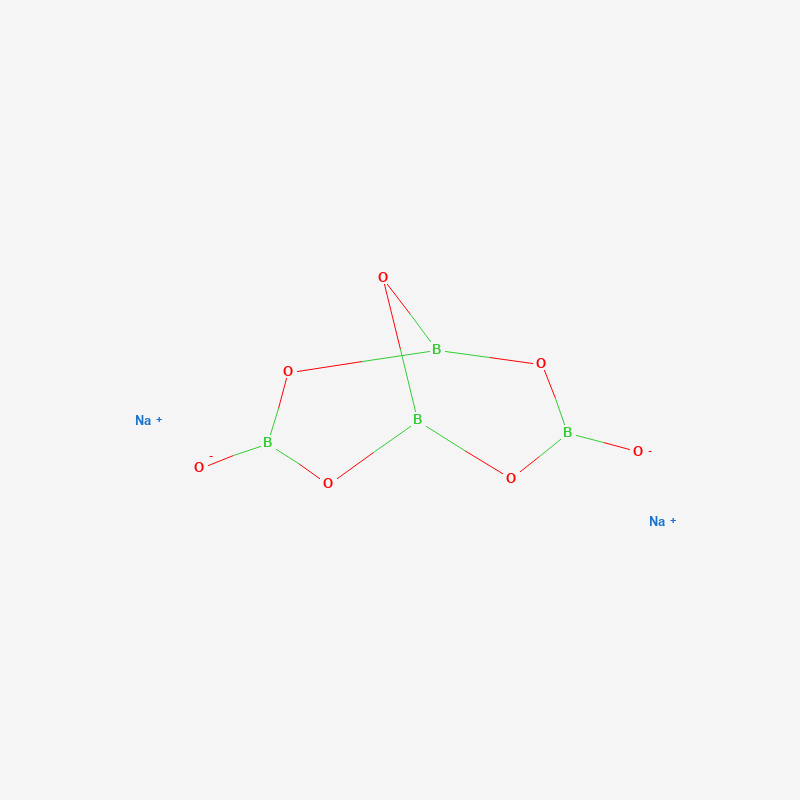
disodium;3,7-dioxido-2,4,6,8,9-pentaoxa-1,3,5,7-tetraborabicyclo[3.3.1]nonane
sodium tetraborate CAS No: 1330-43-4 sodium tetraborate Molecular formula: B4Na2O7 PubChem CID: 10219853
Hazard
Danger
sodium tetraborate Chemical Manufacturers and suppliers listings
No active product listings for sodium tetraborate chemical yet.
sodium tetraborate Structure
1.25×
sodium tetraborate Formula
- CAS Number
- 1330-43-4
- Molecular formula
- B4Na2O7
- Molecular weight
- 201.2
- Exact mass
- 201.9811616
- IUPAC name
- disodium;3,7-dioxido-2,4,6,8,9-pentaoxa-1,3,5,7-tetraborabicyclo[3.3.1]nonane
- SMILES
B1(OB2OB(OB(O1)O2)[O-])[O-].[Na+].[Na+]- InChI
InChI=1S/B4O7.2Na/c5-1-7-3-9-2(6)10-4(8-1)11-3;;/q-2;2*+1- InChIKey
UQGFMSUEHSUPRD-UHFFFAOYSA-N
Data source: Pubchem
view
sodium tetraborate Synonyms (68 total)
12267-73-1
1310383-93-7
1330-43-4
215-540-4
8191EN8ZMD
AKOS015903865
AKOS030228253
Anhydrous borax
B4Na2O7
Borax, anhydrous
Borax Anhydrous
Borax dehydrated
Borax, dehydrated
Borax, fused
Borax glass
Boric acid, disodium salt
Boron sodium oxide (B4Na2O7)
CHEBI:38892
DB14505
Dehybor
Boric acid (H2B4O7), disodium salt
Boric acid (H2B4O7), sodium salt
disodium;3,7-dioxido-2,4,6,8,9-pentaoxa-1,3,5,7-tetraborabicyclo[3.3.1]nonane
DISODIUM BICYCLO[3.3.1]TETRABOROXANE-3,7-BIS(OLATE)
disodium;[oxido(oxoboranyloxy)boranyl]oxy-oxoboranyloxyborinate
Disodium salt of boric acid
Disodium tetraborate, anhydrous
DTXSID101014358
E-285
EBC-66061
EINECS 215-540-4
F0001-6063
F099321
FR 28
Fused borax
Fused sodium borate
Granubor
HSDB 5025
INS-285
INS NO.285
Komex
MFCD00081185
MFCD00163147
MFCD07784974
Na2B4O7
Rasorite 65
RefChem:1098863
SCHEMBL15872
Sodium biborate
Sodium borate (anhydrous)
Sodium borate anhydrous
Sodium borate, anhydrous
SODIUM BORATE [MI]
SODIUM BORATE [WHO-DD]
Sodium boron oxide
Sodium boron oxide (na2b4o7)
Sodium pyroborate
Sodiumtetraborate
Sodium Tetraborate
Sodium tetraborate anhydrous
Sodium Tetraborate, Anhydrous
Sodium tetraborate, anhydrous, Puratronic
SODIUM TETRABORATE [HSDB]
Sodium tetraborate (Na2B4O7)
Sodium tetraborate,Trace metals grade 99.95%
SODIUM TETRABORATE [VANDF]
Spraybor
UNII-8191EN8ZMD
sodium tetraborate Safety & hazards
Signal wordDanger
Hazard statements
- H319 (53.2%): Causes serious eye irritation [Warning Serious eye damage/eye irritation]
- H360 (88.5%): May damage fertility or the unborn child [Danger Reproductive toxicity]
- H315: Causes skin irritation [Warning Skin corrosion/irritation]
- H319: Causes serious eye irritation [Warning Serious eye damage/eye irritation]
- H335: May cause respiratory irritation [Warning Specific target organ toxicity, single exposure; Respiratory tract irritation]
- H360: May damage fertility or the unborn child [Danger Reproductive toxicity]
- H370: Causes damage to organs [Danger Specific target organ toxicity, single exposure]
- H372: Causes damage to organs through prolonged or repeated exposure [Danger Specific target organ toxicity, repeated exposure]
- H320: Causes eye irritation [Warning Serious eye damage/eye irritation]
- H373: May causes damage to organs through prolonged or repeated exposure [Warning Specific target organ toxicity, repeated exposure]
- H402: Harmful to aquatic life [Hazardous to the aquatic environment, acute hazard]
- H412: Harmful to aquatic life with long lasting effects [Hazardous to the aquatic environment, long-term hazard]
- H302: Harmful if swallowed [Warning Acute toxicity, oral]
Data sourced from PubChem
